Stella: understanding and acting on every student before it's too late
Stella is a predictive intelligence system designed to understand, anticipate, and manage critical outcomes in students' academic pathways (such as dropout). By analyzing institutional data with artificial intelligence models, Stella identifies at-risk students with up to 86% accuracy, triggers timely interventions, and significantly improves results: up to 19% less semester dropout and up to 48% more effective support actions.
Stella operates as a student success platform at universities across Latin America and Spain as part of Foris Suite.
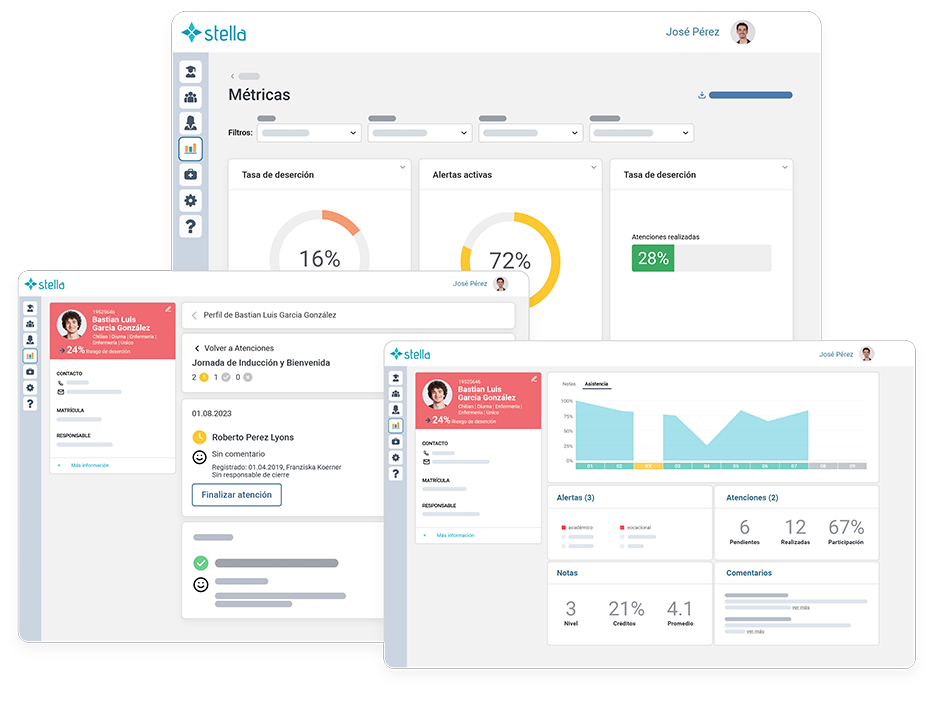
Universities operate at scale. Every academic term involves thousands of students, multiple programs, complex academic rules, and teams trying to support academic pathways that are rarely linear. From a macro perspective, the institution can track overall indicators such as dropout rates, average performance, or levels of progress. The real challenge, however, lies in what happens at the individual level.
The problem lies not in the availability of information but in the ability to turn data into decisions in time. Even though there are multiple sources, there is no clear picture of what is happening with each student at the right moment. The signals are there, but they are scattered, disconnected, and invisible to day-to-day operations. By the time they finally show up in institutional indicators, it is too late to intervene effectively.
The blind spot in academic operations
At most institutions, student support is built on what is known as Operational Blindness: more and more information is available, but there is less real ability to turn it into timely decisions. Teams have to serve hundreds or thousands of students without clear priorities, which inevitably leads them to operate reactively.
This leads to three structural problems:
- No clarity on whom to prioritize
- Late detection of risk signals
- No systematic measurement
The impact shows directly in institutional indicators:
- 70% of university administrators acknowledge that their systems are not up to the task of handling the complexities of student retention (Inside Higher Ed)
- 40% of early warning systems fail to identify at-risk students (Journal of Learning Analytics)
- 70% of universities lack predictive analytics for student retention and success (Gartner)
In many contexts:
- Between 20% and 40% of students show some level of risk during the academic term
- A significant share of those cases do not receive timely intervention
- Many support actions are not carried out or are not recorded correctly
While teams operate at the limit of their capacity, critical outcomes keep unfolding unchecked. Only 22% of students graduate on time. Five out of 10 never graduate, and 30% drop out in the first two years because of a lack of effective support strategies (National Student Clearinghouse).
By the time these cases finally appear in indicators such as dropout, there is little room left to act. Operational Blindness is a problem with the model, not with institutional will: institutions arrive late because they lack mechanisms that let them see in time.
What is Stella, and why does it change the model?
Stella is an artificial intelligence solution for student support that lets institutions understand, anticipate, and act on the different outcomes that affect students' academic pathways. Stella turns data into operational decisions in the institution's day-to-day work.
Unlike traditional tools focused on reports or isolated indicators, Stella operates as a cross-cutting intelligence layer that brings together academic, financial, institutional, and behavioral information to build a unified picture of each student.
At the core of Stella are AI-based profiling algorithms that combine different approaches, such as multivariate models, decision trees, and dynamic segmentation, to understand student behavior from multiple dimensions. These models let Stella identify patterns and also build dynamic profiles that evolve with each student interaction.
Stella makes it possible to understand what is happening with each student and to transform how the student experience is managed. Instead of static segmentation, it builds a dynamic reading of the student population: it identifies not only who is at risk but why, and it connects that diagnosis with concrete support actions.
This approach changes the management model because it lets institutions handle each student's real complexity without losing scalability. Not every case has the same causes or requires the same actions, and Stella makes it possible to manage that diversity in a structured way.
| Result | Value |
|---|---|
| Reduction in semester dropout | 19% |
| Accuracy in predicting outcomes | 86% |
| Effectiveness of support actions | Up to 48% |
Stella is part of Foris Suite, Foris's AI-native university management platform, which also includes Darwin for academic planning and Albus for student enrollment.
How does Stella work?
Stella operates as a continuous intelligence system that turns data into concrete decisions and actions within academic operations. It connects data integration, analytical modeling, and operational execution in a unified, constantly evolving workflow.
1. Data integration and unification
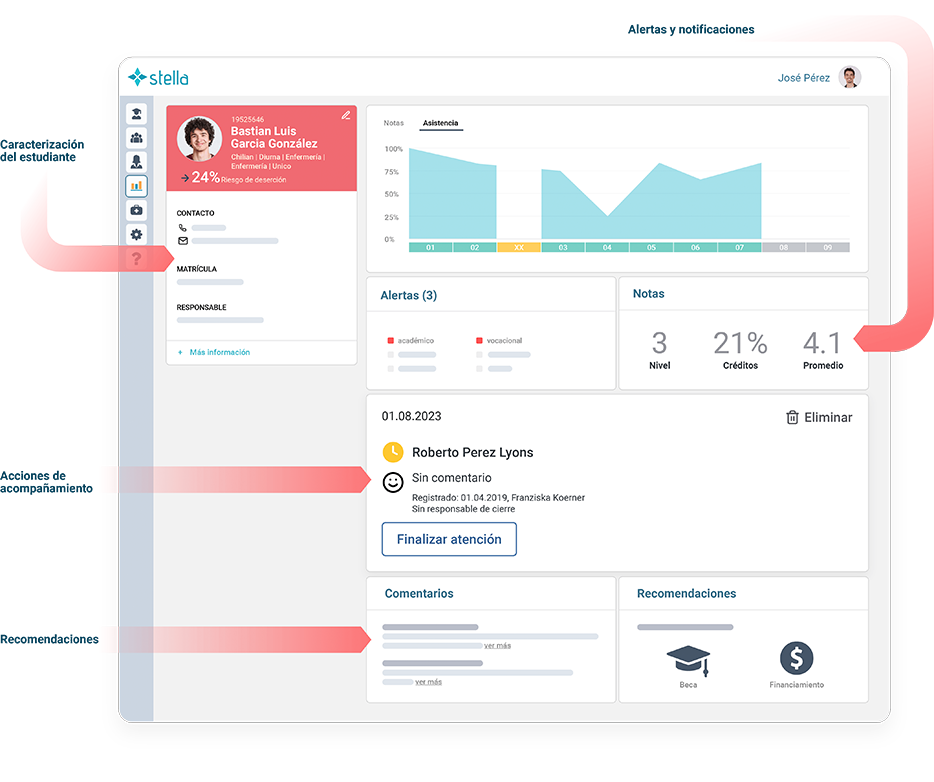
Stella consolidates information from multiple institutional systems (academic, financial, administrative, and interaction data) to build a unified student database.
- Integrates heterogeneous sources (SIS, LMS, CRM, financial systems, and others)
- Normalizes and structures data for consistent analysis
- Builds a complete view of each student throughout their academic pathway
This layer is key because it eliminates information fragmentation, one of the main obstacles to timely decision-making.
2. Profiling and prediction models
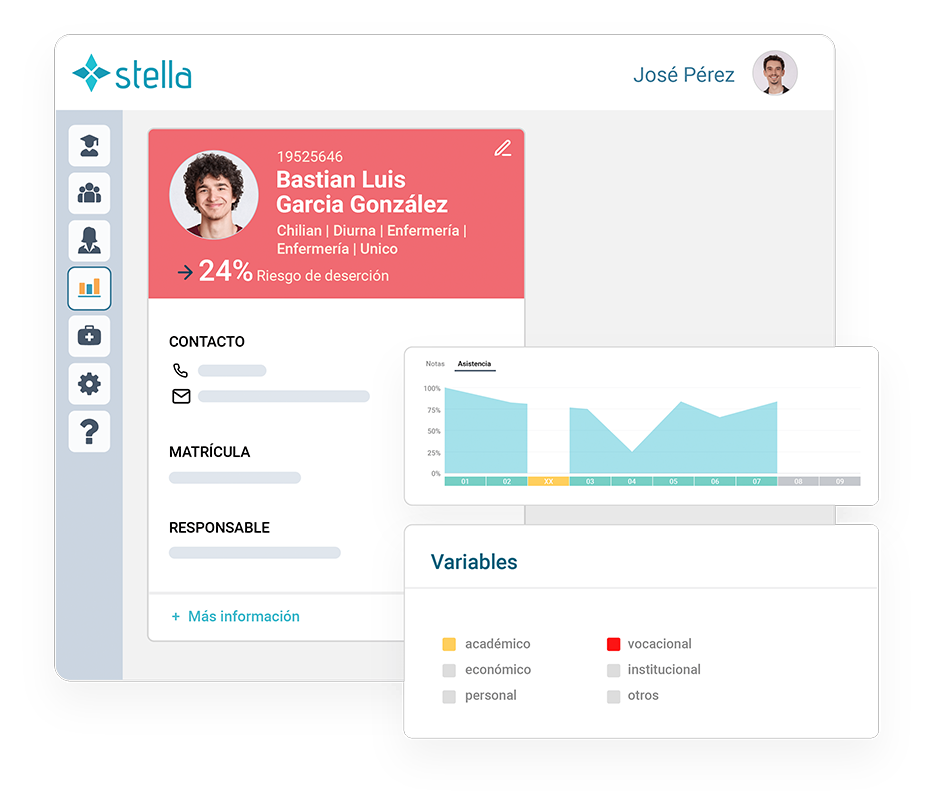
Stella applies artificial intelligence algorithms and statistical models to understand and anticipate student outcomes.
- Supervised multivariate models: estimate the probability of outcomes such as dropout or low performance, using multiple variables simultaneously and learning from the institution's historical data.
- Decision trees for segmentation: identify combinations of variables that explain specific behaviors, generating interpretable, actionable segments.
- Feature selection and validation: techniques such as chi-square, logistic regression, and mutual information to prioritize the variables with the most explanatory power and keep noise out of the models.
- Dynamic behavior profiles: the models are not static; they evolve with new data, continuously adjusting each student's profile.
This combination lets Stella operate as an explainable system, where every prediction comes with context.
3. Signal identification and prioritization
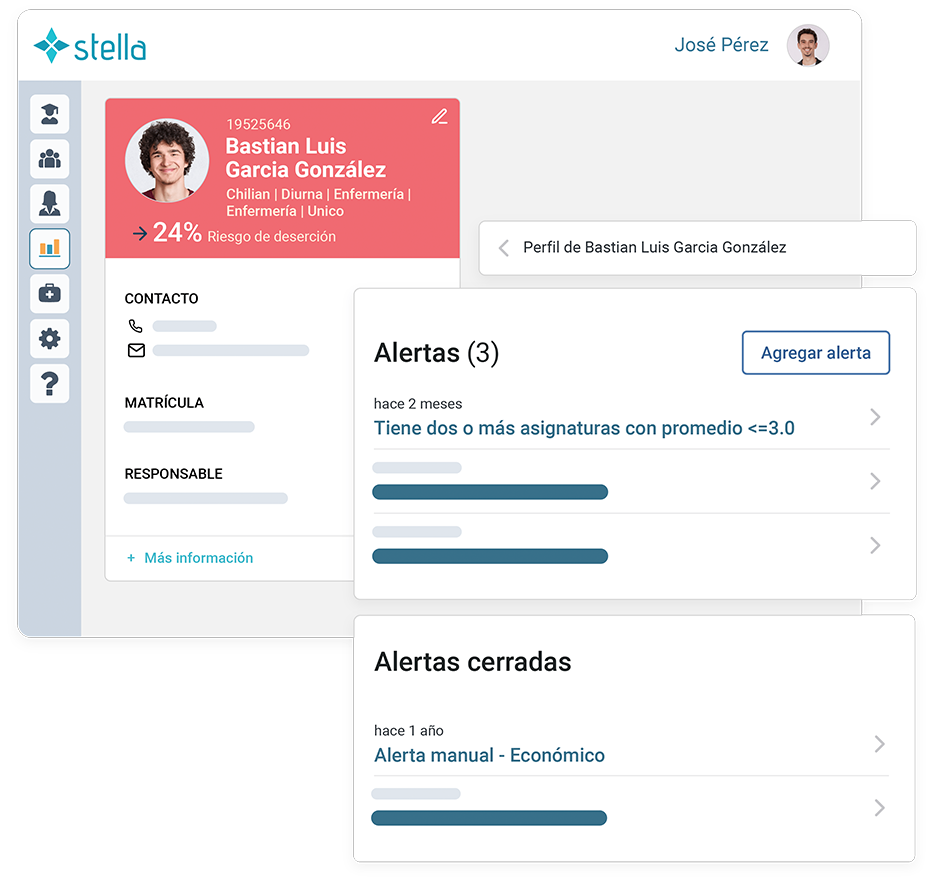
Stella translates analytical results into clear signals for institutional operations.
- Identifies at-risk students in real time
- Prioritizes cases by probability, impact, and urgency
- Groups students into segments with shared characteristics
This makes it possible to move from reactive management to evidence-based prioritization.
4. Triggering support actions
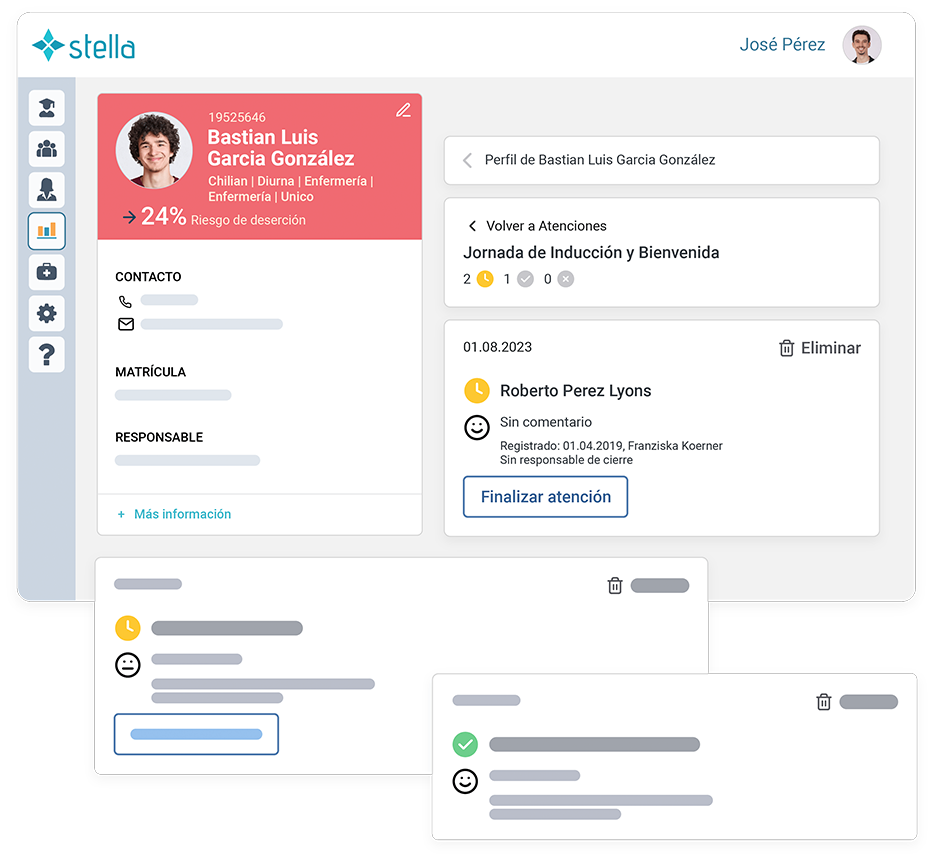
Every signal Stella generates connects directly with institutional operations.
- Case assignment to the responsible teams
- Differentiated actions by risk type or segment
- Structured follow-up on every intervention
This is where analytics becomes real execution, closing the gap between insight and action.
5. Measurement and continuous learning
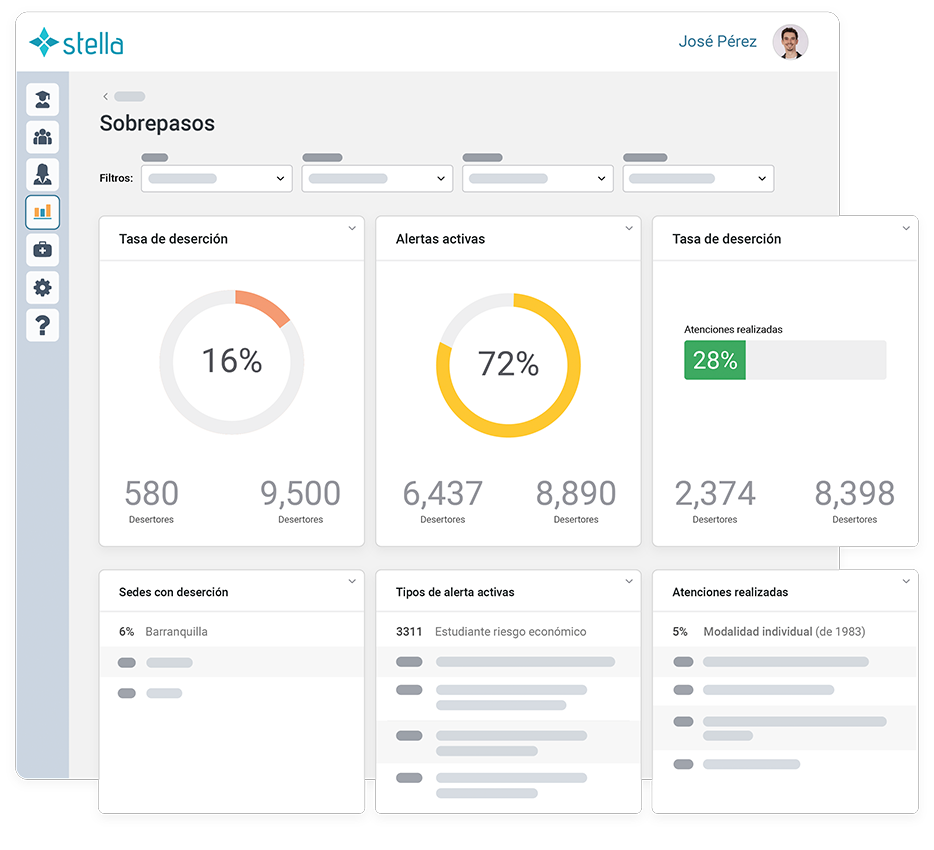
Stella measures the impact of each action and uses that information to keep improving.
- Evaluation of intervention effectiveness
- Model feedback with new data
- Continuous adjustment of rules, segments, and predictions
This cycle lets the system become progressively more accurate and effective over time.
One platform, multiple student outcomes
In higher education, each institution faces different outcomes throughout students' academic pathways. Some are widely known, such as dropout or graduation, while others reflect dynamics specific to each academic context, program, or population.
These outcomes are not static: they evolve over time, are influenced by multiple variables, and require management that combines analysis, anticipation, and coordinated action.
Stella makes it possible to tackle this complexity from a single platform, enabling institutions to identify, analyze, and manage multiple outcomes centrally and at the level of each individual student.
The main outcomes that can be managed include:
- Student dropout and its different forms (cyclical, structural, by program or campus)
- Graduation and progress toward a degree
- Course pass rates and course repetition
- Academic performance and changes in grade point average
- Student satisfaction and engagement with the institution
- Continued enrollment and academic progression
- Access to benefits such as scholarships or financial aid
- Academic choices (program, concentration, degree options)
- Later outcomes such as employability or income
Stella can model and manage any outcome that is relevant to each institution's specific context, adapting to its strategic priorities and the nature of its student population.
Beyond dropout analytics tools
Today, many institutions have already taken an important step: they have adopted analytics tools focused on outcomes such as student dropout.
These solutions consolidate information, display indicators, and identify risk levels within the student population; they are a significant step forward compared with fully manual models.
In practice, however, their scope usually stops at analysis.
- They identify which students are at risk, but do not clearly explain why
- They provide information, but do not prioritize where to act first
- They require additional interpretation to translate findings into concrete actions
- They operate as isolated layers, disconnected from teams' day-to-day work
Stella builds on that foundation but goes a step further. It identifies and explains outcomes and triggers decisions directly within the academic ecosystem where those outcomes occur.
In practice, this translates into a continuous flow:
- Stella profiles each student and detects relevant patterns in their behavior
- This information connects with academic planning, so the course offerings can be adjusted to specific profiles and needs (Darwin)
- At enrollment, specific decisions can be guided by recommending the most suitable combinations, sections, or pathways for each student (Albus)
- Actions stop being generic and become contextual, built directly into the moments when students make decisions
The value thus lies in understanding risk and in acting on it within the institution's real processes.
What used to be an analytics tool becomes an institutional capability to actively manage each student's academic pathway, as an integrated intelligence layer across all academic operations.
Stella positions itself as a student success platform for higher education in the region, standing apart from analytics tools by bringing prediction, intervention, and impact measurement together in a continuous cycle connected to academic operations.
If your institution wants to understand how Stella can adapt to its context, learn about Stella here or book a demo to see in detail how Stella supports your case.
Glossary: key terms in this article
Operational Blindness: a concept that describes a university's structural inability to turn its data into timely student support decisions. It is not a problem of will or of available information but of the model: teams operate without the mechanisms to see what is happening with each student at the right moment.
Predictive dropout model: an ML algorithm trained on the institution's historical data that estimates the probability that a student will leave their studies in a given term. In Stella, these models reach up to 86% accuracy.
Student support: the set of actions an institution carries out to support its students' academic pathways, including counseling, financial intervention, psychosocial support, and academic advising.
Frequently asked questions
What is Stella by Foris?
Stella is a predictive intelligence system for universities that analyzes institutional data to identify and anticipate critical outcomes in students' academic pathways, such as dropout, course failure, financial risk, and graduation. It identifies at-risk students with up to 86% accuracy, triggers timely interventions, and measures the impact of each action.
How does Stella predict student dropout?
Stella combines supervised multivariate models, decision trees, and feature selection techniques to build individual risk profiles. The models are trained on each institution's own historical data and are continuously updated with new data.
What results do universities get with Stella?
Institutions that implement Stella report up to a 19% reduction in semester dropout, 86% accuracy in predicting student outcomes, and up to 48% effectiveness in the support actions carried out by their teams.
How is Stella different from other dropout analysis tools?
Most tools identify who is at risk but do not explain why or prioritize where to act. Stella goes further: it connects the diagnosis with concrete actions within the institution's operations, integrating with academic planning (Darwin) and enrollment (Albus).
Is Stella only for managing dropout?
No. Stella can model any measurable outcome in a student's academic pathway: graduation, course failure, financial risk, continued enrollment, access to scholarships, employability, and more. The platform adapts to each institution's strategic priorities.
Is Stella a student success platform?
Yes. Stella works as a student success platform for universities. It brings risk prediction, intervention activation, and impact measurement together in a cycle connected with academic planning and enrollment within Foris Suite. It operates at institutions across Latin America and Spain.