Multiple Selection in Albus: enrolling in linked courses and sections in a single workflow

Multiple Selection in Albus is the feature that lets students enroll in several sections or related courses at the same time, such as a lecture and its practice session, in a single workflow. The system automatically detects the valid combinations defined by the institution, with no extra effort from students or academic staff, ensuring that every enrollment follows the current academic structure.
Why aren't traditional systems ready to handle enrollment in courses or sections that are linked to each other?
Traditional enrollment systems were designed for a simple model: the student picks a course, chooses a section, and the system records the selection. That logic works well for standalone courses, but it falls short when workflows are less straightforward and the institution defines relationships between courses: a lecture course with its practice session, a course with its lab, or a course with its required equivalent. Without control over business rules in the enrollment workflow, the system could let incomplete or invalid enrollments through. A student might select the lecture without the associated lab, or complete an enrollment that looks valid on screen but does not actually comply with the university's academic regulations. If we accept the limitations of the enrollment system at the moment students choose their courses and sections, then the registrar's office and support teams have to absorb manual corrections, after-the-fact validations, and time-consuming adjustments.
Multiple Selection in Albus: one workflow for all the academic complexity
Albus is Foris's smart enrollment platform. Its AI-based recommendation engines guide each student to the best selection of courses and sections for their study plan, in a personalized way, without friction, and without relying on staff at every step of the process.
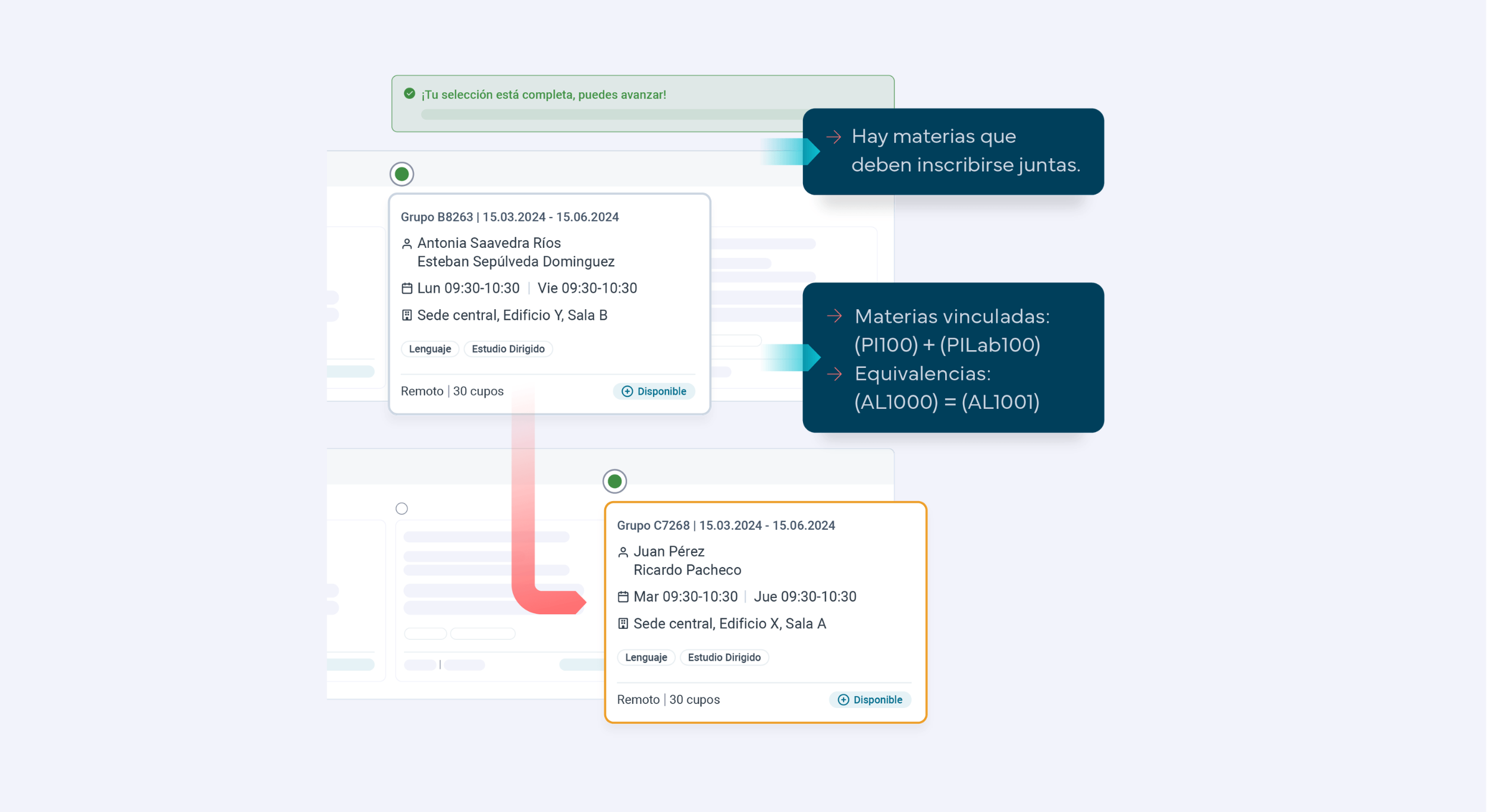
With the Multiple Selection feature, Albus now solves the problem of linked courses within the same workflow. Students enroll in all the sections associated with a course in a single interaction, with the guarantee that any combination the system lets them select is valid. The three main benefits are straightforward:
- It lets students correctly enroll in linked courses within a single workflow.
- It optimizes the use of sections and their seats by allowing courses to be linked, which enables a more flexible and efficient allocation of student choices. This improves load balancing across the available options and increases the likelihood that students will find valid alternatives.
- It improves the student experience by avoiding multiple screens or fragmented processes.
How does Multiple Selection work in Albus?
The feature kicks in when the system detects that a course has associated links: the workflow automatically switches from simple selection to multiple selection mode. Students don't need to turn anything on or go to another screen: the logic adapts to the context of the course they are enrolling in.
"This ensures that enrollment follows the academic structure defined by the institution at all times" Carol Aceituno, Albus PO
For academic teams, multiple section selection also adds an administrative feature for managing equivalencies. From there, they can show and hide courses, adapting how the system behaves to each institution's particular needs without any additional development.
The platform leading institutions trust to guide enrollment and comply with current regulations
Institutions do not run on simple study plans. Some follow fixed curricula; others, flexible curricula in which each student builds their own pathway. In both cases, enrollment must follow current academic rules, and equivalencies and other types of links between courses are part of those rules. Albus's Multiple Selection feature is designed for exactly that level of complexity. Unlike other systems on the market, it dynamically detects when a course requires selecting multiple sections and enforces the business logic across all the selected sections at every step.
"Students complete enrollment in a single, clear, and controlled interaction." Carol Aceituno, Albus PO.
The value is not only operational. By correctly modeling the relationships between courses, Albus's Multiple Selection feature expands the course offerings available to students: they can see valid equivalencies, compare options, and choose the one that best fits their schedule and pathway, knowing that the system only shows them combinations the institution has defined as correct.
This translates into three concrete capabilities for the institution:
- Modeling academic structures: lecture courses linked to practice courses, direct and complex equivalencies (2x1, 3x1, etc.), or linked sections (Course A - Section 5 + Course - Section 5), without simplifications that compromise the integrity of the process.
- Broader course offerings for students: more valid alternatives available, more autonomy to choose, and less reliance on staff to make decisions.
- A single, frictionless navigation workflow: academic complexity is no longer blocked by operational hurdles and becomes an intuitive option in the enrollment workflow.
With Albus, institutions stop fixing errors after enrollment and start preventing them through the very design of the process.
Does your institution already have access to the Multiple Selection module? If not, now is the time to discover it 👉 www.foris.ai/albus