Albus: from university enrollment to an intelligent student experience
Albus is a smart enrollment platform for higher education that uses AI-based recommendation algorithms to generate a personalized schedule proposal for each student, taking into account their curricular progress, their preferences, and institutional rules. Unlike traditional systems, Albus recommends, validates, and guides students from the start, turning reactive enrollment into a continuous experience with no errors or delays.
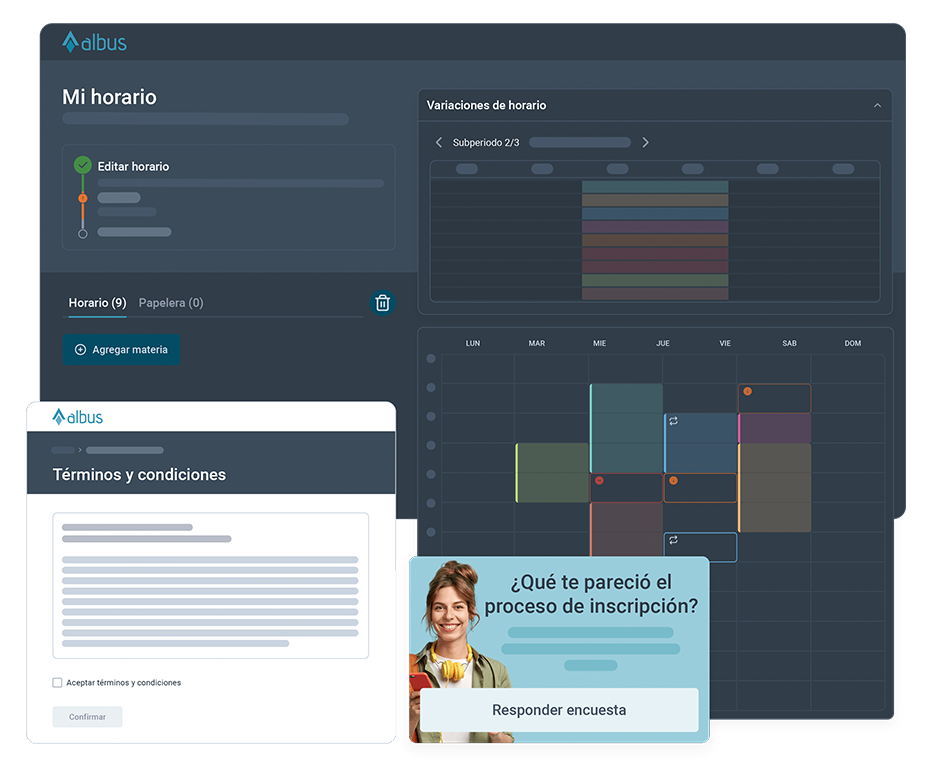
University enrollment is a critical moment where thousands of decisions, academic rules, operational constraints, and student expectations converge… all at the same time.
In just a few hours, thousands of students have to make decisions that affect their progress, while the academic platform validates rules, manages seats, and processes payments in real time.
When something fails, the consequences are immediate:
- Students without a seat.
- Invalid enrollments.
- Operational overload.
- Delays in students' academic pathways.
And yet many universities still rely on systems built to record information, not to orchestrate this level of complexity in university enrollment.
Why is enrollment still a structural problem?
If enrollment is so critical, why does it keep failing at so many universities? The answer lies in the systems that support it.
Historically, higher education institutions have managed enrollment with academic systems designed to record information and ensure administrative control. They work well as data repositories, but they were not designed to handle complex decisions in real time.
And that is exactly what enrollment is: a decision problem.
Each student has to put together a valid combination of courses, taking into account academic rules, availability, curricular sequences, and operational constraints. At the same time, the institution has to ensure those decisions are consistent, scalable, and aligned with its existing capacity.
When this logic runs on transactional systems, the result is predictable:
- Interfaces that display information but do not guide decisions.
- Validations that happen at the end, not during the process.
- Manual intervention to resolve exceptions.
- Fragmentation across academic, financial, and operational areas.
This pattern is called Reactive Enrollment: a model in which errors are detected late, corrected with friction, and repeated term after term because the system was not designed to anticipate them.
Industry data shows the scale of the problem. During demand peaks, 20% of enrollment systems experience significant outages or slowdowns. Twelve percent of enrollments fail on the first attempt because of technical problems (Educause Review), and when something goes wrong, the average time to resolve it is 2 to 3 days (Inside Higher Ed). That delay directly affects students and strains support teams, which see a 50% increase in requests for help during enrollment (National Student Clearinghouse).
This is where Albus comes in: a smart enrollment platform for higher education.
What is Albus?
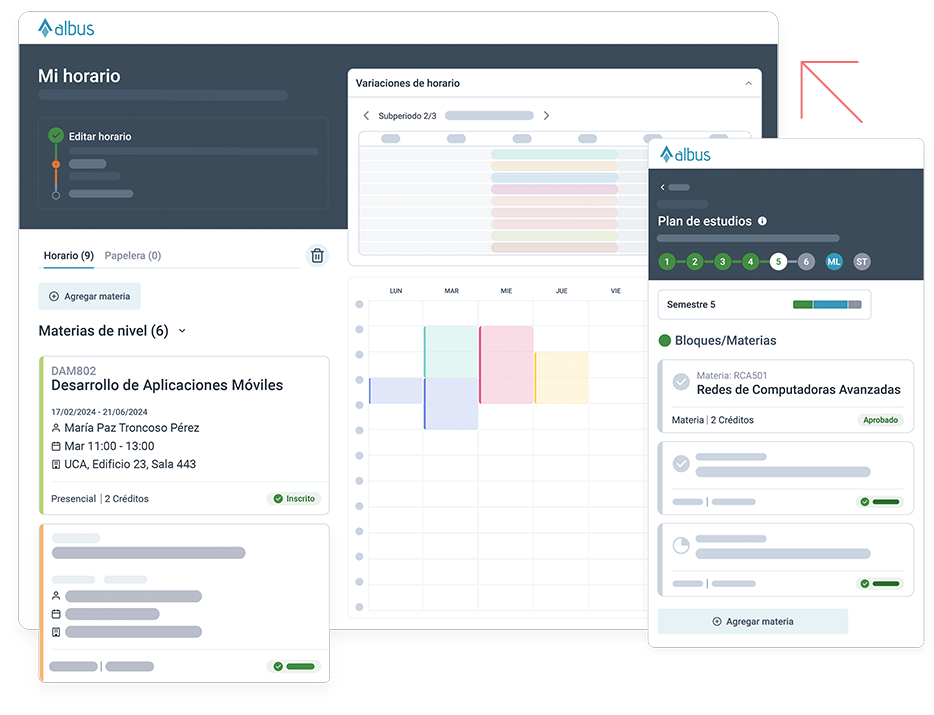
Albus is a smart enrollment platform for higher education that uses AI-based recommendation algorithms to build a personalized schedule proposal for each student, based on their academic pathway, their preferences, and institutional rules.
Instead of facing complex course offerings during enrollment, students receive a recommendation that already takes into account:
- Their curricular progress and outstanding requirements.
- Their preferences (schedules, course load, interests).
- The available course offerings (courses, sections, seats).
- All academic rules and institutional constraints.
The result is an optimized schedule proposal, ready to confirm so students can move forward with no errors or delays.
This approach profoundly changes the enrollment experience. In traditional systems, students have to navigate multiple screens, interpret rules that are not always obvious, and cross-check information on their own. They make decisions with incomplete context and often discover errors only after those errors have already affected their academic pathway. At its core, the logic is simple: the system displays, and the student figures it out.
Albus reverses that logic: it recommends, validates, and guides from the start, so students make decisions with greater certainty instead of by trial and error. It also helps students understand their curricular progress, make decisions about their pathway, manage their academic and financial status, and receive alerts or recommendations, all in one coherent environment.
At institutions with between 5,000 and 30,000 students that use Albus, more than 70% of students accept the generated schedule proposal, the process takes about 15 minutes, and up to 80% of students complete it on mobile devices.
Beyond enrollment, Albus works as the central student experience platform: a single place where students check their progress, make academic decisions, review their financial situation, and receive personalized recommendations. This unified approach sets it apart from traditional transactional portals, where each function lives in a different system.
Albus capabilities: for students and for the university
Albus transforms the enrollment experience from two perspectives: that of students, who make better decisions, and that of the university, which manages the process with more flexibility and a greater ability to anticipate.
For students
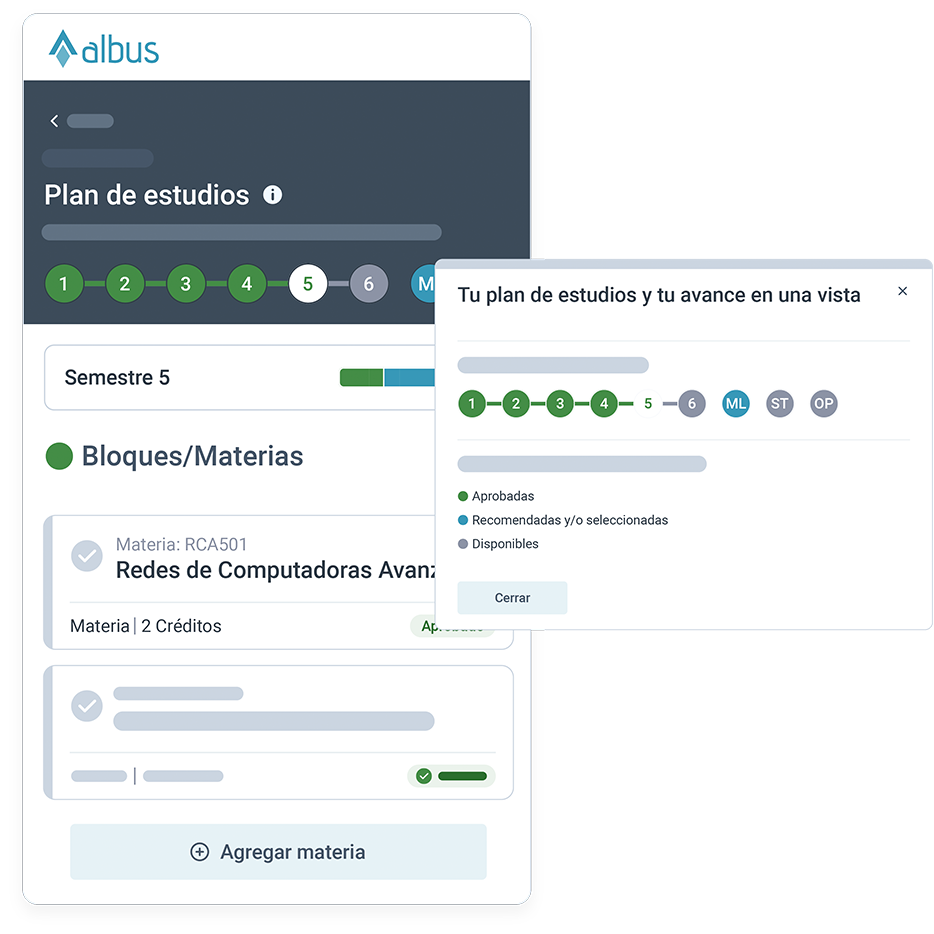
Guided, frictionless enrollment
- Schedule proposals aligned with their curricular progress and institutional rules.
- Smart recommendations that prioritize viable combinations based on academic context and preferences.
- Ready-to-choose schedule packages with no seat conflicts, time clashes, or prerequisite issues.
- A choice between complete alternatives, with no need to build combinations course by course.
Informed decision-making
- A clear view of curricular progress that identifies completed courses, pending courses, and restrictions.
- Dynamically suggested study paths, adjusted to their history and to the actual availability of course offerings.
- An implicit simulation of how each choice affects their academic progress.
Every decision stops being a matter of intuition and becomes an AI-assisted decision with full context, which is reflected in the fact that more than 70% of students confirm the generated proposal without changes.
For the university
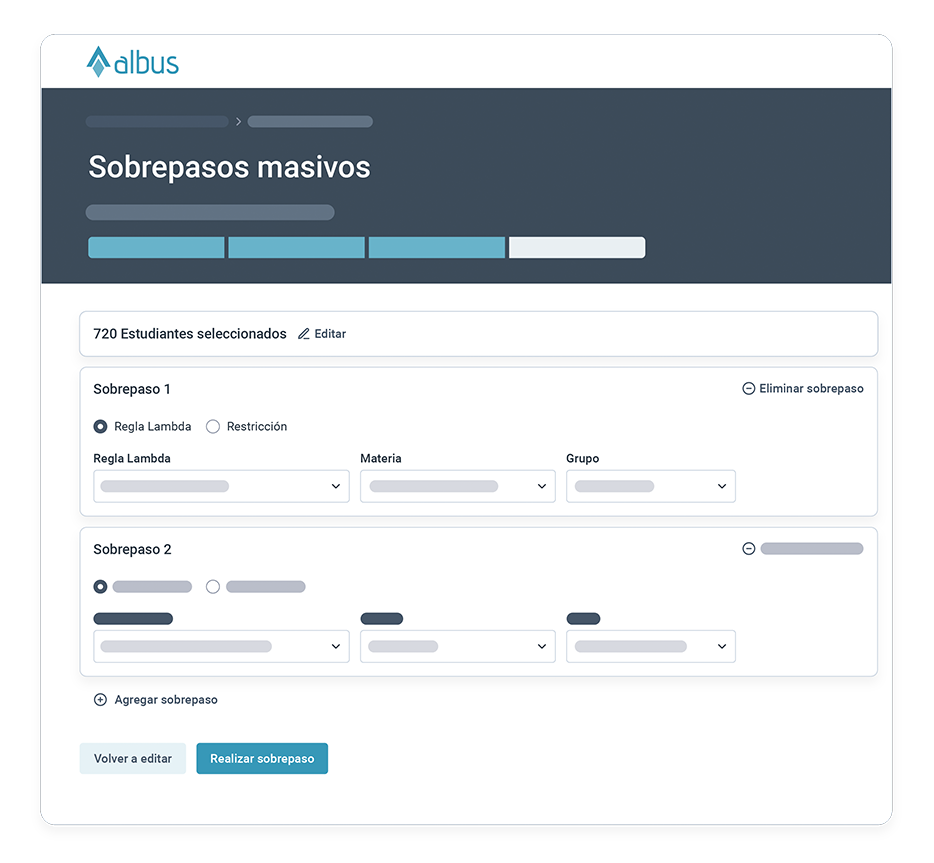
More efficient operations
- Demand estimates based on historical behavior and enrollment patterns, not just static forecasts.
- Smart distribution of students across sections to maximize occupancy and avoid bottlenecks.
- Integrated management of seats, schedules, and course offerings based on actual demand.
- Fewer conflicts, less over-enrollment, and less rework.
Real-time monitoring and support
- A module for academic staff to see each student's enrollment progress in real time.
- The ability to step in, assist, and resolve blockers during the process without leaving the enrollment workflow.
- Active support that reduces friction and improves the student experience at critical moments.
Process control and consistency
- Automatic, real-time validation of academic rules throughout the entire workflow.
- Errors prevented before they happen, instead of corrected afterward.
- Consistent enrollment from the first attempt, even under high concurrency.
- Fewer operational exceptions and less administrative workload.
Flexibility and institutional fit
- Flexible business rule configuration, without relying on technical development or code changes.
- Real-time adjustments during the enrollment process.
- Adaptation to different academic models (credits, blocks, cohorts, etc.).
- Interfaces and workflows customized by user type, with no additional development.
Albus within an academic intelligence ecosystem
Enrollment does not happen in isolation: it depends on how the course offerings are planned, how resources are managed, and how each student's academic pathway evolves.
When these elements are disconnected, enrollment becomes a fragmented process: planning defines the course offerings, operations react to demand, and students navigate the complexity on their own.
Within Foris Suite, enrollment is coordinated with other key systems in the academic ecosystem:
- Darwin, which forecasts demand, plans the course offerings, and defines the structure of schedules, instructors, and classrooms.
- Albus, which turns planning into a guided, frictionless enrollment experience with recommendations.
- Stella, which supports students throughout their academic pathway, bringing together academic decisions, alerts, and personalized recommendations.
This connection means enrollment is no longer an isolated step but an orchestration layer, where each enrollment decision meets an immediate need and also aligns with a broader vision of operational efficiency and student success.
Albus turns enrollment into a continuous, guided experience aligned with each student's academic situation. Within Foris Suite, Albus connects with Darwin to receive the planning and with Stella to continue supporting students, operating as a system in which enrollment is one layer of the complete academic cycle.
Want to see how Albus can transform enrollment at your university? Discover Albus or book a demo and we'll show you how it works at institutions like yours.
Glossary: key terms in this article
Reactive enrollment: a management model in which seat, prerequisite, or academic rule errors are detected and corrected after they have already happened, creating rework, friction, and recurring administrative workload.
Personalized schedule proposal: a combination of courses generated by Albus for each student, optimized based on their curricular progress, preferences, and institutional rules, and ready to confirm with no conflicts.
Albus: Foris Suite's smart enrollment platform for higher education. It uses AI-based recommendation algorithms to give each student a tailored schedule proposal and turn enrollment into a guided, frictionless experience aligned with each student's academic pathway.
Foris Suite: an AI-native university management platform that automates the most complex processes of academic operations: from demand forecasting and schedule generation, through enrollment, to the early detection of at-risk students. It works as a central intelligence and management layer that integrates with the institution's existing technology ecosystem, connecting data, processes, and decisions in one coherent experience.
Guided enrollment: an approach in which the system recommends, validates, and supports students throughout the course selection process, instead of simply displaying options and expecting students to figure it out on their own.
Frequently asked questions
What is Albus?
Albus is a smart enrollment platform for higher education that uses AI-based recommendation algorithms to generate personalized schedule proposals. It takes into account the student's curricular progress, preferences, and institutional rules, and delivers a ready-to-confirm combination of courses with no conflicts or errors. It operates at universities across Latin America and Spain as part of Foris Suite.
Why does university enrollment still fail at so many institutions?
Because traditional academic systems were designed to record information, not to manage complex decisions in real time. The result is a reactive enrollment model in which seat, prerequisite, or academic rule errors are fixed after they happen instead of being prevented from the start.
How does Albus generate a schedule proposal?
Albus analyzes the student's curricular progress, preferences, the available course offerings, and institutional rules. With that information, it generates an optimized schedule proposal, ready to confirm with no seat conflicts, time clashes, or missing prerequisites.
What results do universities get with Albus?
Institutions using Albus see schedule proposal acceptance above 70%, an average enrollment time of 15 minutes, and up to 80% of their students completing the process on mobile devices.
How does Albus integrate with other university systems?
Albus runs within Foris Suite and connects with Darwin, which plans the course offerings, and with Stella, which supports the student's academic pathway. Albus also integrates with each university's existing academic ecosystem.
Does Albus also work as a student portal?
Yes. Beyond enrollment, Albus works as a student portal where each student checks their curricular progress, manages their enrollment with AI recommendations, reviews their financial status, and receives personalized support.