Foris Intelligence: an AI-native platform to run academic operations
Foris Intelligence is Foris Suite's artificial intelligence layer. It combines optimization, machine learning, and AI agents on an AI-native platform to turn data, rules, and processes into decisions that run directly on academic operations.
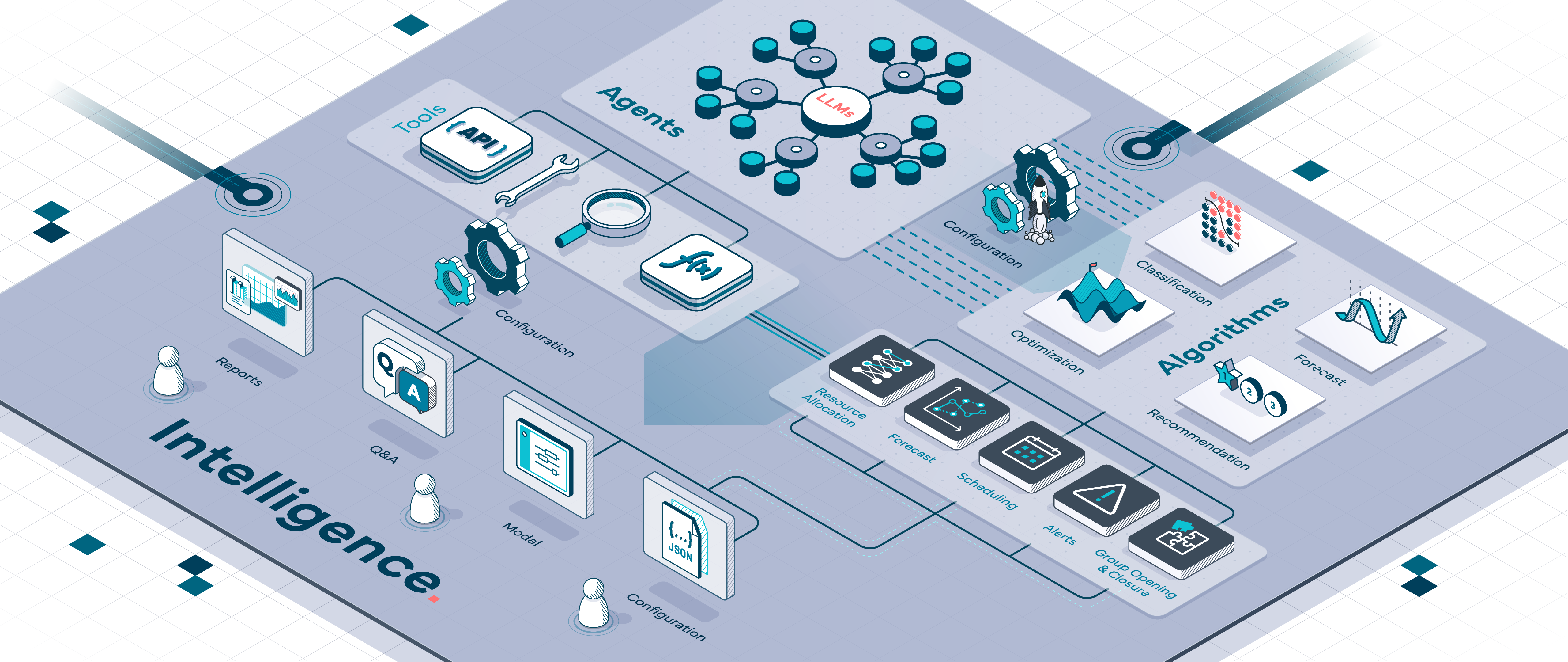
In higher education, operational complexity is the result of how academic processes are designed.
- Enrollment is more than selecting courses: it means resolving curricular rules, the student's financial status, seat availability, and operational constraints all at once.
- Academic planning goes beyond opening sections: it requires forecasting demand, assigning instructors, and balancing existing capacity across campuses.
- Student support goes beyond monitoring: it means interpreting academic, financial, and interaction signals to decide whom to reach out to, when, and with what action.
Every academic process brings together multiple variables at the same time. That is why, when it comes to artificial intelligence at universities, the challenge is not only adding models but also defining where they operate and which layer of the system they can act on.
The limits of student information systems are not about a lack of data
Student information systems have historically been designed to guarantee transactional consistency: they are highly efficient at storing information, validating rules, and recording statuses within academic operations.
However, they were not designed to:
- Interpret context dynamically across academic, financial, and operational domains
- Evaluate multiple variables simultaneously to support complex decisions
- Execute intelligent actions directly on institutional processes
When analytics capabilities, predictive models, or artificial intelligence in general are added, they are usually implemented outside the core system, in data warehouses, BI tools, or isolated initiatives.
As a result, intelligence makes it possible to understand what is happening, but not to act on it. Decisions depend on intermediate steps and manual validations, and critical operations keep running without intelligent support in real time.
Beyond a technological limitation, this is a structural architectural limit. Foris calls it decoupled intelligence: models, analytics, and AI capabilities that coexist with the university's operating system but cannot execute decisions on actual operations.
What changes on an AI-native platform
An AI-native platform is defined not by its use of artificial intelligence models but by being designed so that intelligence operates directly on the system's logic, rather than as an external layer.
This requires three technical conditions that are rarely present in traditional architectures, and that really determine whether AI can execute or only analyze.
1. Data structured to be consumed by language models
Intelligence works when data is connected, organized, and available at the moment it is needed. In an institution's daily operations, this shows up in very concrete situations:
- An academic unit forecasts demand based on historical enrollment data
- Finance manages account statement and payment behavior data
- Institutional systems record key student events, such as enrollments, payments, requests, and changes in their academic pathway
When this data lives in separate systems or with different structures, every decision requires manual cross-checking, additional validations, and long response times, directly affecting the institution's ability to anticipate and act in time.
For example, identifying an at-risk student means combining their course load, their financial behavior, and their interaction patterns; without integration, this reading arrives late or remains incomplete.
In Foris Suite, this is solved with two components:
- Data Platform (the central data infrastructure), which consolidates institutional information in a Data Lakehouse, providing a single, consistent, up-to-date version of the data
- Data Gateway (the data access layer), which exposes this information as a unified API, so models and agents can query the data directly, quickly, and in a standardized way
This reduces reliance on ad hoc integrations and speeds up access to reliable information for each use case. Intelligence can then operate with broad context, from opening sections to prioritizing student interventions.
2. Institutional rules as executable entities
At many universities, rules live in scattered configurations, legacy code, or the tacit knowledge of the person who has been in the department for fifteen years. That limits their traceability and makes it hard for intelligent systems to operate on them.
On an AI-native platform, rules are centralized and declarative, and they can be interpreted by both humans and machines. In Foris Suite, this is achieved with a proprietary DSL and a specialized AI agent that lets users create, describe, and query rules in natural language.
The same rule that runs a critical process such as enrollment can be understood, validated, and adjusted by an academic analyst without depending on the technical team, keeping definition and execution consistent.
3. End-to-end orchestrated processes
Intelligence needs to act on complete processes, not on fragments. This means operational workflows are defined, connected, and available as tools that agents can trigger directly.
In daily operations, processes such as academic planning or enrollment involve multiple units, rules, and decision points. When these workflows are fragmented, each step depends on manual intervention and switching between tools, which slows down execution and makes it hard to keep the process moving.
When processes are structured end to end, AI can go from recommending to executing directly on operations. For example, it can launch a demand forecast, trigger an alert, run rules in bulk, or reschedule sections within the system, connecting analysis and execution in a single workflow.
This lets intelligence become part of the operational process, with the ability to act in real time.
Foris Intelligence is built on these three conditions, as a cross-cutting capability that lets intelligence stop observing operations and start being part of them.
The three dimensions of Foris Intelligence
Foris Suite is built on a key principle: far from being a single problem, academic operations are a set of subproblems of different kinds that require different approaches.
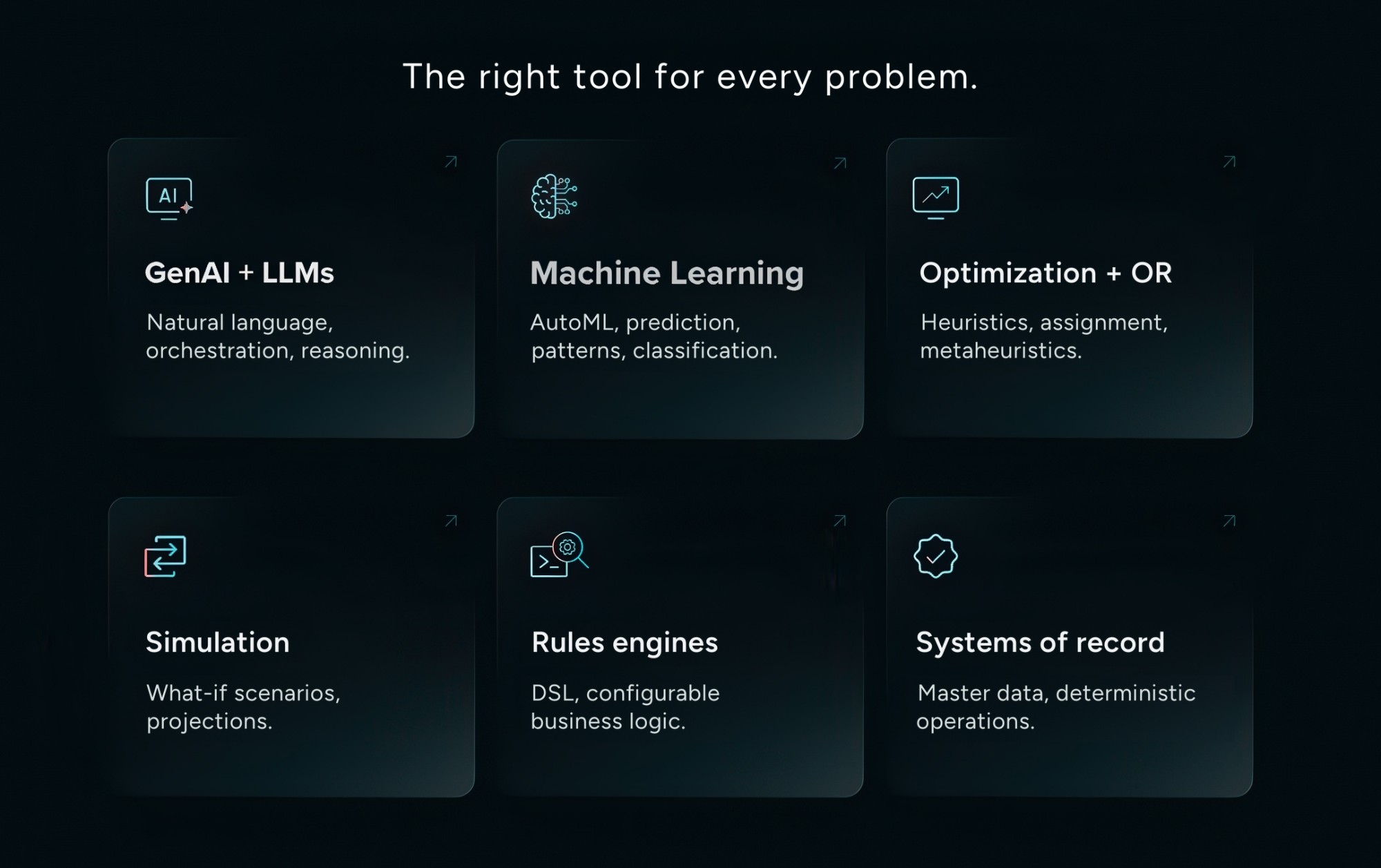
Instead of relying on a single technique, Foris Intelligence operates as a hybrid intelligence platform, where each type of problem is tackled with the most suitable tool, from classical algorithms and optimization to machine learning and generative AI models.
Building on this, Foris Intelligence approaches institutional intelligence from three dimensions, each designed for a different type of problem:
1. Planning and Optimization: solving what doesn't scale manually
Some of the most critical problems in higher education are combinatorial in nature. Course scheduling is the most obvious case.
Building the schedule for an academic cycle means simultaneously evaluating instructor availability, classroom physical capacity, compatibility between courses, forecast demand, curricular constraints, distances between buildings, and compatible schedule packages for each cohort. The number of possible combinations grows exponentially, and solving it by hand takes weeks and produces suboptimal results.
Viktor is the algorithm within Darwin that solves this problem. It implements a metaheuristic approach that combines genetic algorithms, local search, graph search, greedy algorithms, and integer linear programming algorithms, which lets it explore millions of combinations in minutes. It also includes an evolutionary memory structure that accumulates information from previous runs and steers the search toward more promising solutions, progressively improving the quality of the results.
Paul is the other side of the equation. Its job is to forecast academic demand for the next term at a granular level, student by student and course by course, by simulating the curricular progress of each active student through their specific study plan.
For each student, Paul analyzes their curricular progress, the structure of their program, and institutional rules, and from this it generates a set of plausible enrollments, which are then aggregated to build the demand figures.
In this setup, Paul defines the problem and Viktor solves it. The academic team reviews the result in Darwin's demand and schedule editors and makes the necessary adjustments. It is the complete academic design cycle, carried out in an integrated way on a single AI-native platform.
2. Data Analytics & Machine Learning: anticipating with institutional context
Not every problem in academic operations is an optimization problem; many are highly complex prediction problems: dropout, risk of failing, likelihood of payment, or abandoning the enrollment process. These are multivariate phenomena where the value lies in identifying patterns before they materialize.
Foris Intelligence addresses these cases with machine learning techniques based on AutoML with Optuna and MLflow, which trains models on each institution's real data and automatically selects the best combination of algorithms and hyperparameters for each problem. It is a flexible infrastructure that can work with approaches such as Random Forest, Gradient Boosting, neural networks, LogitBoost, or penalized logistic regression.
The entire data pipeline, from normalization and imputation to class rebalancing, is versioned and documented. This improves model quality and makes it possible to understand how each result was reached.
One of the most visible implementations of this capability is the retention model in Stella, and this is where the AI-native architecture makes a deeper difference.
An isolated predictive model that delivers a score is useful but insufficient for operations. Stella's model delivers a score along with an explainable structure that groups students into risk segments that advisors, academic directors, and student wellness teams can read and interpret directly.
It means moving from a flat statement like this:
"This student has a 78% probability of dropping out."
To an actionable structure like this:
"Students with a first-year average below 3.5 who failed at least one basic sciences course and have debt more than two months overdue have a 78% probability of dropping out in the next term."
This reveals actionable patterns: combinations of academic, financial, and behavioral variables that explain that risk in terms the institution can understand.
Student support teams then know whom to contact, understand why, and can focus their intervention on the right variables. At institutions that use Stella, the model reaches up to 86% accuracy in predicting student outcomes and has helped reduce semester dropout by 19%.
The same ML platform can be trained for multiple use cases: risk of failing by course, likelihood of re-enrollment, abandoning the enrollment process, or effectiveness of remedial courses. The model changes depending on the problem, but the architecture that supports it stays the same.
3. LLM & AI Agents: making academic complexity manageable
Even with integrated data and well-built models, a structural barrier persists within universities: system fragmentation. Institutional users don't interact with models; they interact with interfaces, and the interfaces of traditional systems tend to turn that complexity into friction.
AI agents close that gap by enabling a natural-language interaction layer, with real-time access to data and rules and the ability to execute actions within the system.
The value of these AI agents lies in their embedded institutional knowledge: academic rules, curricula, enrollment registration processes, and organizational structures, modeled as ready-to-use tools and knowledge bases.
On the technical side, the agents run on a ReAct architecture with LangGraph, keep configurable memory per user, role, or institution, and escalate to a human when a decision calls for it. The Agents Platform of Foris Suite is agnostic to the LLM provider (OpenAI, AWS Bedrock, Ollama, and others) and supports BYOK schemes, so each institution keeps control over its contracts, data, and costs.
A concrete example illustrates the change: in many systems, configuring an academic eligibility rule means opening a ticket with IT, translating the need into technical specifications, deploying changes, and going through validation cycles that can take weeks. With Foris Intelligence, an academic analyst defines the rule in natural language, and the AI agent translates it into an executable DSL and validates it against the existing catalog to detect collisions before activating it.
The complexity doesn't disappear, but it is no longer a barrier to operating.
Foris Intelligence: a hybrid intelligence ecosystem
Together, these three dimensions operate as an integrated intelligence system applied to academic operations, bringing in a range of techniques designed to solve different problems. From optimization algorithms and machine learning models to AI agents capable of executing actions in real time, each approach plays a specific role within a single AI-native architecture.
Why AI doesn't work as an external layer
This is where the difference between an AI-native platform and a system of record with AI added on stops being conceptual and becomes operational.
A university can connect ML models to a data warehouse, deploy chatbots on top of its information system, or add specialized tools for schedule optimization, and each one may indeed work… within its own space.
However, none of them will be able to:
- Run a demand forecast that takes into account the actual institutional rules (not an exported subset) and write it back into the system that generates the schedules.
- Deliver a dropout score that the advisor can act on from the same portal where they record the intervention, with the explainable profile and the student's full record right alongside it.
- Let an academic analyst change an enrollment rule in natural language and have that rule apply in real time to the student portal's validators.
- Ensure that agents' decisions are executed under the same security schemes, permissions, and financial rules that govern institutional operations.
None of this fails for lack of models: it fails because the intelligence is built outside the system that runs operations. For it to really work, the platform has to be AI-native and designed from the start so that models, rules, and processes share the same operational language.
Foris Intelligence design principles
The Foris Intelligence architecture rests on four structural principles that ensure intelligence is both powerful and operable within the institutional context:
- Explainability: intelligence is designed as a traceable system, in which every prediction, recommendation, or action can be understood and justified, making explicit the variables that influence it and the reasoning behind each decision.
- Adaptability by institution: there are no generic models applied uniformly. Each model is trained on the university's own data, and the rules that govern the algorithms are configurable to reflect each institution's academic, financial, and operational reality.
- Human-in-the-loop: intelligence proposes, but the institution decides. Critical processes always keep human visibility and control, so people can validate, adjust, or step in when the context calls for it.
- Technology neutrality: the platform works with whichever algorithms best fit the data. The architecture protects against lock-in, so the intelligence layer can evolve without rewriting the operational logic the institution runs on.
From analyzing data to running the university
Higher education systems have historically been geared toward recording what has already happened, and that approach is still necessary, because a system without transactional integrity is not a system. But it is no longer enough in a context where decision speed, personalized support, and operational efficiency have become matters of survival.
An AI-native platform adds a further capability: beyond recording statuses, it evaluates scenarios, makes decisions based on multiple variables, and executes them within the system. This capability amplifies institutional logic and makes it operable at scale.
The conversation about artificial intelligence in higher education tends to focus on models, chatbots, algorithms, or specific tools, but the important question is a different one: does the institution's architecture allow that intelligence to act on operations?
Foris Intelligence is the execution core of Foris Suite, connecting planning, enrollment, student support, data, and decisions in a single AI-native platform that runs the university in real time.
Want to see in detail how Foris Intelligence runs a university's academic operations? Learn more on the Foris Intelligence page or book a demo with our team to talk about your institution.
Glossary: key terms in this article
AI-native platform: an architecture in which artificial intelligence is not an additional layer on top of a system of record but the mechanism the platform uses to run its processes. Data, rules, and workflows are designed from the start to be consumed by models and agents.
Decoupled intelligence: a concept that describes situations in which AI models, analytics, or predictive capabilities coexist with the university's operating system but cannot execute decisions on actual operations. The intelligence observes; critical processes remain manual.
Hybrid Intelligence Ecosystem: an integrated system that combines different AI techniques (combinatorial optimization, machine learning, AI agents), each applied to the type of problem it solves best, all running on the same AI-native Foris Suite architecture. It makes it possible to move from point solutions to a cross-cutting intelligence layer over academic operations.
Viktor: the algorithm within Darwin for automated course schedule generation. It combines metaheuristic approaches (genetic algorithms, local search, integer linear programming) with an evolutionary memory that steers the search toward better solutions with each run.
Paul: Foris's academic demand forecasting engine. It simulates curricular progress student by student through each student's specific study plan and aggregates the plausible enrollments into a demand table by course.
Human-in-the-loop: a design model in which AI proposes and the human team validates, adjusts, and decides before anything is executed. It is present in every Foris Intelligence workflow.
Frequently asked questions
What is Foris Intelligence?
Foris Intelligence is Foris Suite's artificial intelligence layer. It combines optimization, machine learning, and AI agents on an AI-native platform to turn data, rules, and processes into decisions that run directly on academic operations.
What does it mean for a platform to be AI-native?
An AI-native platform is designed from its architecture up so that data, rules, and processes can be consumed natively by AI models and agents. Intelligence is not added as an external layer on top of a system of record; it is the mechanism the platform uses to run its processes.
What is decoupled intelligence?
Decoupled intelligence is the term Foris uses to describe models, analytics, and AI capabilities that coexist with the university's operating system but cannot execute decisions on actual operations. It is a structural architecture problem, not an issue with any single technology.
What AI techniques does Foris Intelligence use?
A hybrid approach: metaheuristics and evolutionary algorithms for combinatorial optimization (Viktor), curriculum simulation for demand forecasting (Paul), machine learning to predict student outcomes such as dropout and risk of failing, and AI agents built on ReAct and LangGraph for natural-language interaction with institutional data and rules.
Are the AI models the same for every university?
No. The models are trained on each institution's own data, and the platform automatically selects the combination of algorithms and hyperparameters that best fits each university. The rules that govern Viktor and Paul are also configured per institution, with no intervention from the technical team.
How does Foris ensure human control over AI decisions?
All Foris Intelligence workflows follow a human-in-the-loop model. The AI proposes, and the institution's team validates, adjusts, and decides before anything is executed. Every decision is explainable through interpretable structures that translate the models into terms advisors and leaders can act on.