Core Services: the architecture for scaling academic operations without fragmentation
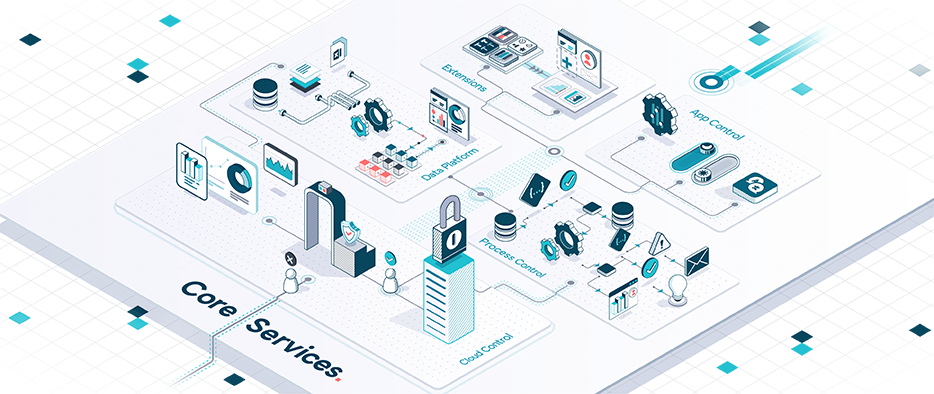
Core Services are a layer of cross-cutting capabilities that centralizes data, rules, processes, and identity in academic operations. In traditional systems, these capabilities tend to be spread across multiple platforms, which creates inconsistencies and high operational complexity. By managing them in a unified way, Core Services let universities operate consistently, scale without friction, and rely less on integrations and manual processes.
For years, universities have digitized their operations by adding specialized systems: one for enrollment, another for finance, another for analytics, and so on. Each works well within its own domain, but the institution operates as an interconnected system where every decision affects multiple areas at once.
The limits of the traditional model
The problem appears when a process spans several systems. A clear example is student enrollment, which determines courses and at the same time affects the student's financial status, academic eligibility, and progress. That journey is where the real friction begins:
- The same information exists in multiple systems, but it doesn't match
- Academic rules are replicated and interpreted differently in each system, without reflecting the full business logic
- Processes depend on fragile integrations or manual work
- Institutional changes take weeks or months to implement
Over time, this creates not only inefficiency but also structural friction. We call this problem Operational Fragmentation: the condition in which each system manages its own data, rules, and integrations independently, preventing the institution from operating as a coherent whole. Changing a rule means touching multiple systems, and trusting the data requires validating it against more than one source. Automating processes becomes complex because the logic is scattered, so operations end up working, but at the cost of constant effort and heavy reliance on manual processes.
This is an architecture problem more than a tooling problem.
From independent systems to shared capabilities
The turning point lies not in adding new tools but in changing how the capabilities all tools need in order to operate are organized. In the traditional model, each system manages its own data, rules, integrations, and access logic, which creates local autonomy but breaks global coherence.
The Core Services approach starts from a different idea: cross-cutting capabilities should live in a common layer that supports every product, as the foundation the entire institution runs on.
When these capabilities are no longer embedded in each system and are managed centrally instead, operations stop depending on synchronization and start resting on a single, coherent source.
In practice, this means:
- Data is no longer replicated; it is managed in a unified way
- Rules are defined once and applied consistently
- Processes are orchestrated, instead of depending on point-to-point integrations
- Access is controlled from a central identity, not a fragmented one
This shift addresses the root cause of the problem: it eliminates duplicated logic and makes operations consistent by design.
What are Core Services, and what do they solve together?
Core Services are a layer of cross-cutting services that brings together the fundamental capabilities of academic operations: data, rules, processes, and identity. Instead of being spread across multiple systems, these capabilities are managed in a unified way, so the entire institution operates on a coherent foundation.
More than an additional component, Core Services work as the logical infrastructure that connects and supports every product. Their value lies not in replacing existing systems but in eliminating the fragmentation that arises when each system handles these capabilities separately.
For this layer to work, Core Services organize operations into specific capabilities. Each one solves a type of structural problem and, together, they let systems operate on a common foundation without losing specialization.
Entity: a single source of truth to unify and govern all academic entities
Entity is the data core of the academic ecosystem. It centralizes, consolidates, and exposes information on programs, courses, study plans, students, instructors, campuses, schedules, and enrollments, serving as the authoritative representation of the institution's academic state.
Unlike traditional systems, where each platform manages its own catalogs and structures, Entity receives and unifies the information produced by the different modules of Foris Suite and by external systems. This lets each product operate with the logic it needs, while Entity maintains an integrated, consistent view.
The result is an operation where data is no longer fragmented and every system reads from and writes to the same foundation, eliminating duplication, inconsistencies, and the need for complex synchronization.
Identity: a centralized identity and access layer to manage users in complex, multi-tenant environments
Identity is the identity authority of Foris Suite. It manages who each user is, how they authenticate, and what they can do within the ecosystem, centralizing authentication and authorization for every product.
It is designed for complex university environments, where multiple types of users (students, instructors, administrative staff) and organizational structures (schools, campuses, programs) coexist. Its hierarchical, multi-tenant model lets multiple units operate within the same platform while keeping data, configurations, and operating contexts isolated.
Identity decouples access management from applications, so roles, permissions, and relationships can be defined centrally, ensuring a consistent user experience and consistent enforcement of security policies across the entire suite.
Built on standards such as OAuth2 and OpenID Connect, it enables Single Sign-On (SSO), federation with institutional identity providers, and a seamless, secure sign-in experience across systems.
The result is an operation where identity is no longer a distributed problem and becomes a centralized, secure, and governed capability.
Financial: a unified financial back office to manage charges, payments, and reconciliation with traceability
Financial centralizes the financial logic of academic operations, defining and executing the charge items, billing rules, discounts, surcharges, and account statements associated with the student's academic pathway.
It lets institutions configure complex charging schemes based on academic variables such as program, term, enrolled credits, or student profile, ensuring that financial settlement responds directly to institutional logic. On this foundation, it supports bulk processes to generate, adjust, and update charges.
This logic is triggered as part of the institution's academic and administrative processes, ensuring that every event that affects operations has a consistent, traceable financial counterpart.
This enables scenarios such as:
- Adjusting charging policies without development
- Automating the bulk generation of charges
- Reconciling payments with banks and institutional financial systems in a traceable way
- Keeping what is charged consistent with what is recorded in the accounting system
It also ensures full traceability of financial operations, recording the events that affect each account statement and making it possible to audit changes throughout the financial cycle.
Data Platform: an integration and data layer to connect, transform, and activate institutional information
Data Platform is a data and integration platform designed for higher education institutions. It solves one of the main bottlenecks at universities: data access, integration, and availability.
It enables integration between the academic ecosystem and external systems, with bidirectional data syncing with SIS, ERP, CRM, and LMS platforms. Through configurable pipelines (JDBC, APIs, S3, and others), it consolidates, transforms, and distributes data in a standardized way, avoiding point-to-point development and reducing integration complexity.
This layer consistently feeds the platform's data, process, and analytics capabilities, ensuring information is available for operations, decision-making, and the development of intelligence capabilities.
Its impact shows on three levels:
- Integration: it eliminates the need for ad hoc integrations between systems by standardizing how data connects and flows within the ecosystem.
- Processing: it transforms and prepares data through configurable pipelines, without relying on complex development, ensuring consistent information flows.
- Use: it centralizes data in a Data Lakehouse architecture, making it available for analysis, reporting, and artificial intelligence models.
It also acts as the bridge between legacy systems (ERPs, LMSs, traditional SIS platforms) and the suite's products, so the institution can evolve gradually without replacing its existing infrastructure.
This enables use cases such as:
- Syncing data between systems automatically
- Feeding dashboards and reports with up-to-date information
- Preparing data for predictive models
- Exposing information to AI agents in a controlled way
The result is an operation where data is no longer fragmented and becomes an available, reliable, and structured asset, ready to support both day-to-day operations and advanced analytics and intelligence capabilities.
Process Platform: an orchestration layer to model, execute, and govern complex academic processes
Process Platform centralizes the institution's operational logic to define, execute, and monitor academic processes in a structured way, decoupled from applications.
Through workflow, rules, and bulk processing engines, it orchestrates flows that involve multiple systems, data sources, and decisions, ensuring each process runs consistently and traceably.
Instead of splitting logic across multiple systems, Process Platform lets institutions configure and control processes from a central layer, making them easier to evolve without complex development and reducing reliance on technical teams for operational changes.
It integrates natively with Entity, Data Platform, and Financial, consuming data, executing rules, and triggering actions across different systems within the ecosystem.
Its impact shows in:
- Orchestration: it coordinates end-to-end processes that span multiple systems and domains (academic, financial, operational), ensuring consistent execution.
- Automation: it reduces manual intervention through configurable workflows, business rules, and background task execution.
- Execution at scale: it supports bulk processing of operations, so processes can run efficiently over large volumes of data.
This enables use cases such as:
- Automating enrollment, withdrawal, or academic change processes
- Running complex validations based on institutional rules
- Orchestrating flows that affect academic and financial areas simultaneously
- Processing bulk operations without manual intervention
The result is an operation where processes no longer depend on scattered logic and become centralized capabilities that can adapt to institutional complexity.
Agents Platform: an intelligence layer to execute processes and decisions in natural language
Agents Platform is the infrastructure for deploying, configuring, and governing artificial intelligence agents on top of academic operations.
Unlike generic AI platforms, its value lies in its embedded institutional knowledge and its native integration with the Suite's systems. The agents work with real data, academic rules, and institutional processes through tools connected via the Model Context Protocol (MCP), with no need for additional integrations.
The platform enables agents specialized in key tasks, such as rule configuration, enrollment assistance, process interpretation, or academic support, that can take actions, look up information, and guide decisions in real time.
It also supports complex agentic workflows, integration with knowledge bases through RAG, contextual memory per user or institution, and centralized governance over agent usage, costs, and behavior.
Its key differentiators are:
- Access to institutional knowledge: it integrates knowledge bases (regulations, curricula, policies, rules) through semantic retrieval mechanisms, ensuring contextualized answers.
- Assisted execution: it lets agents interact with real systems, take actions, and participate in operational processes, always with visibility, data access control, and management of the costs associated with language model usage.
This enables use cases such as:
- Assisting students with enrollment and academic decision-making
- Configuring rules and workflows in natural language
- Diagnosing process errors and suggesting corrective actions
- Automating operational interactions without direct human intervention
The platform is agnostic to the language model provider, so it can work with different providers without depending on a single one and adapt to cost or privacy constraints.
The result is an operation where system complexity is abstracted into intelligent interfaces, so people can interact with processes and data naturally without losing control or traceability.
A foundation for what's next
As universities move toward more flexible, personalized, data-driven models, this layer becomes structural: it enables integration, efficient operations, and an institution ready to adopt AI agents effectively.
Agents cannot work with fragmented systems: they need an architecture where data flows, processes are connected, and rules are consistent from end to end. Without that, AI is limited to superficial layers with no real impact.
Core Services provide that foundation: they connect, organize, and structure operations so they work better today and so any agent can understand them, make decisions, and act on them. Without this architecture, AI only papers over operations without solving their complexity.
In Foris Suite, Core Services are the infrastructure on which Darwin, Albus, and Stella run, connecting academic planning, enrollment, and student support in a system designed to work as a coherent whole. Today, more than 65 higher education institutions across Ibero-America run on this layer as part of Foris Suite.
Want to understand how Core Services integrate with your current ecosystem? Discover Core Services or book a demo with the team.
Glossary: key terms in this article
Operational Fragmentation: a structural problem of the university ecosystem in which each system manages its own data, rules, and integrations independently. It creates inconsistencies, manual processes, and heavy reliance on synchronization between platforms.
Core Services: a layer of cross-cutting capabilities that centralizes data, rules, processes, and identity in academic operations. In traditional systems, these capabilities tend to be spread across multiple platforms, which creates inconsistencies and high operational complexity. By managing them in a unified way, Core Services let universities operate consistently, scale without friction, and rely less on integrations and manual processes.
Data Lakehouse: a data storage architecture that combines the flexibility of a data lake with the structured query capabilities of a data warehouse. In Foris Suite, it is the centralized repository that feeds analytics, reporting, and AI models.
Model Context Protocol (MCP): an integration protocol that lets AI agents connect with institutional systems and tools in a standardized way, without point-to-point integrations for each data source.
Multi-tenant: a software architecture in which a single platform serves multiple institutions or organizational units with complete isolation of data, configurations, and operating contexts.
Frequently asked questions
What are Core Services in a university platform?
Core Services are a layer of cross-cutting capabilities that centralizes academic data, rules, processes, and identity. Instead of spreading these capabilities across multiple systems, they manage them in a unified way so the whole institution operates on a consistent foundation.
What components do Foris Suite's Core Services include?
Core Services include six components: Entity (a single source of academic data), Identity (centralized identity and access management), Financial (a unified financial back office), Data Platform (data integration and pipelines), Process Platform (academic process orchestration), and Agents Platform (infrastructure for AI agents).
Why is Operational Fragmentation a problem for universities?
Because each system manages its own data, rules, and integrations independently. When a process spans multiple systems, the information does not match, rules are interpreted differently, and institutional changes take weeks to implement.
Do Core Services replace the university's SIS or ERP?
No. Core Services act as an integration layer that connects and complements existing systems. They integrate with SIS, ERP, LMS, and CRM platforms through Data Platform, so the institution can evolve gradually without replacing its infrastructure.
How do Core Services enable AI agents at a university?
AI agents need consistent data, connected processes, and unified rules. Core Services provide that foundation: Entity centralizes academic data, Process Platform orchestrates processes, and Agents Platform deploys agents on real institutional knowledge through native integration.
Do Core Services include a data platform for higher education?
Yes. Foris Suite's Data Platform connects databases, APIs, and files from any institutional system (SIS, ERP, LMS), transforms them, and makes them available in a unified Data Lakehouse for analytics, AI models, and real-time reporting.