Darwin adds Access Conditions Management
** A rules system to decide who can enroll in each course.**
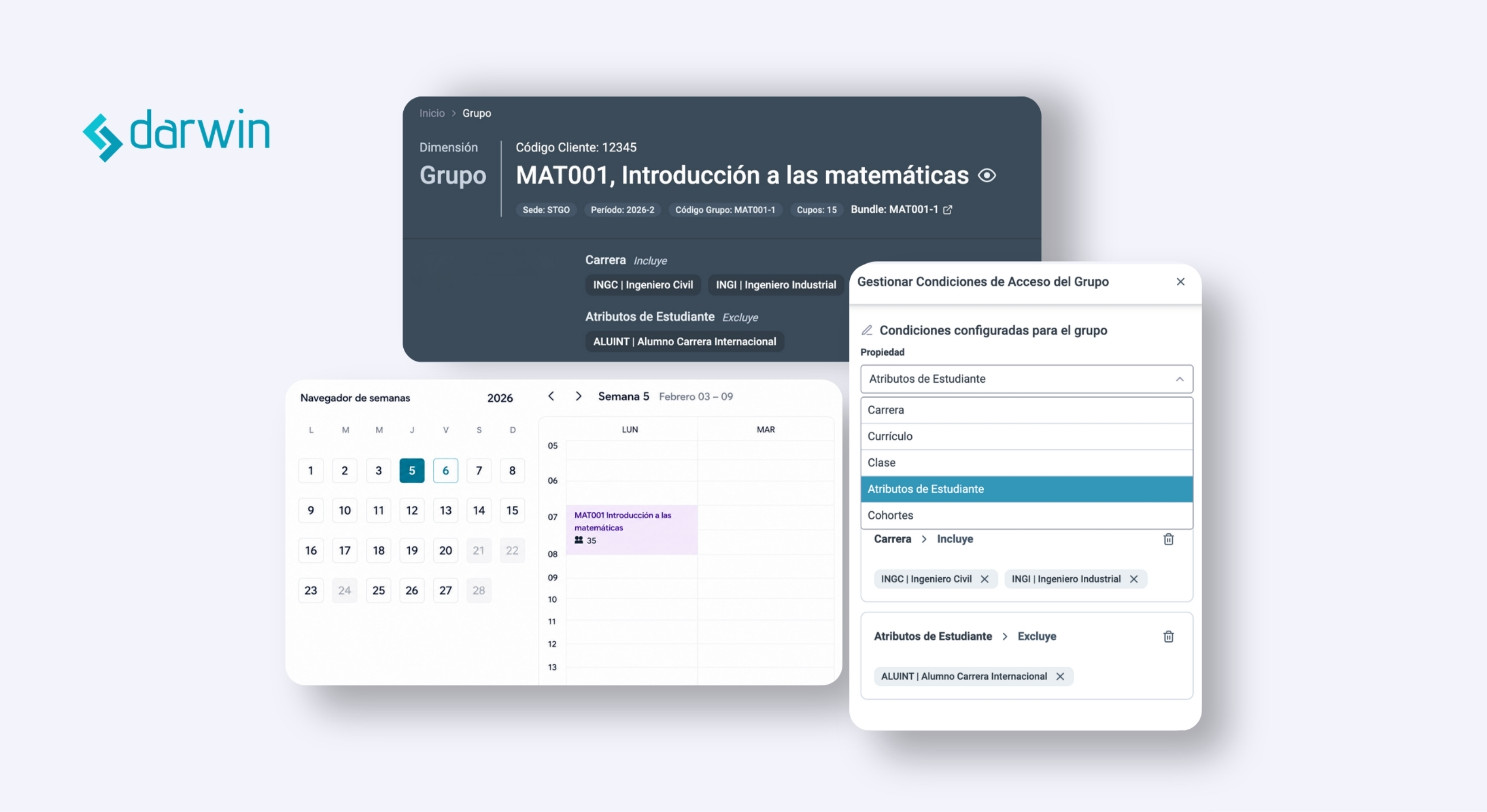
Access Conditions Management is the Darwin feature that defines which students can enroll in each section of the course offerings. It applies eligibility rules by program, campus, academic progress, or other criteria and validates them in real time together with Albus, with no external systems or manual reviews.
Access Conditions Management is a Darwin feature that lets you define the conditions a student must meet to enroll in each section available in the published schedule. This rules engine connects directly with the enrollment system (Albus) and shows, in real time, which students can or cannot enroll in each section, without using external systems or running manual validations.
Academic planning is not only about building schedules. It also means defining precisely which students can access each section, especially at large universities with highly complex operations, where that control tends to be scattered.
With this improvement, Darwin builds eligibility control directly into the academic planning process, removing external dependencies and making the course offerings more consistent.
What is Access Conditions Management?
In practice, defining who can enroll in each section tends to be a slow, error-prone process, with teams checking information across different systems and resolving cases by hand.
Access Conditions Management solves this directly: you define clear rules that the system applies automatically at the time of enrollment, ensuring that each student can only see and enroll in the sections that actually apply to them based on their program, campus, academic progress, or other criteria.
For example, a section can be set up so that only students in the architecture program can access it. Or, in a more complex case, only students in the architecture program who are up to date on their enrollment fee payments and have not previously failed the same course.
The key is that these conditions are not predefined or limited by rigid structures. They can be easily combined and adjusted to each institution's needs, so you can define simple or advanced rules without relying on complex configurations or additional development, and adapt quickly to academic or operational changes.
The problem: fragmented eligibility at universities
At many universities, student eligibility control is not built into the main academic planning system. It is managed in parallel systems or by hand, which leads to:
- Duplicate information.
- Inconsistency across systems.
- A heavy operational workload for academic teams.
- A higher likelihood of enrollment errors.
In the end, the operational cost shows up as more time, more validations, and more room for error.
The solution: flexible eligibility rules built into academic planning
With Access Conditions Management, rules are no longer scattered: they are configured directly in Darwin, in the same place where the course offerings are built. This brings more clarity and avoids later adjustments, moving from a reactive approach to a controlled, predictable one.
Key capabilities:
Centralized academic rules
All eligibility rules live in one place, with no dependence on external tools and a much simpler operation.
Flexibility across educational models
It lets you combine standard and custom criteria based on each institution's needs.
Automation
Rules can be applied automatically. If a course is only for Engineering students, all of its sections inherit that condition without being configured one by one.
Impact on academic operations
This change reduces the time spent configuring and validating the course offerings, minimizes errors in the enrollment process, and improves the student experience, since students now get clear information about what they can enroll in.
Where is it configured?
Conditions can be managed in different ways depending on the need, from one-off adjustments to larger uploads.
They can be configured directly on each section when something specific is required, applied in bulk to multiple sections or courses, or integrated with other institutional systems.
In every case, the logic stays centralized and aligned with academic planning, which prevents inconsistencies and makes it easier to maintain.
How it differs from other systems
Many tools, including several traditional SIS platforms, let you define access conditions or restrictions, but they do so as external layers or rigid configurations, disconnected from day-to-day operations.
Darwin is different: it builds these rules directly into academic planning and connects them with the enrollment process in real time. It includes:
- Flexible, easy-to-maintain rules that can be adjusted without complexity or duplication.
- Validations at the time of enrollment that apply automatically, with no manual steps.
- An experience designed for academic teams, so they don't need constant technical support.
Availability
The feature is available now and can be activated with the Foris service team, which guides the setup according to each institution's model.
This is one more step toward intelligent academic planning. If your team still handles eligibility outside the system or through manual processes, this change can make an immediate difference in control, efficiency, and the enrollment experience.
If you want to see it in action and understand how to apply it to your operations, let's talk.
Glossary: key terms in this article
Access rules engine: a system that evaluates predefined conditions (if the student meets attribute X, they can enroll in section Y) and automatically determines whether a student can access a given section, with no manual intervention in each case.
Academic eligibility: the set of conditions that determine whether a student is allowed to enroll in a specific section. It can include variables such as program, campus, academic level, delivery mode, or other institutional criteria.
Restriction hierarchy: a configuration model in which the rules defined for a course are automatically inherited by all of its associated sections, avoiding repetitive setup and ensuring consistency.
Real-time validation: the process by which the system evaluates a student's eligibility at the exact moment they try to enroll, with no delays or later manual checks.
SIS (Student Information System): a system that centralizes academic and administrative data. Darwin integrates with the institutional SIS to keep planning and enrollment consistent.
Frequently asked questions
What is Access Conditions Management in Darwin?
It is a Darwin rules engine that automatically defines which students can enroll in each section of the course offerings, validating their program, campus, academic progress, or other configured criteria in real time, with no external systems or manual reviews.
How does it connect with the enrollment process?
The rules engine connects directly with Albus. The moment a student tries to enroll in a section, Darwin already knows whether they are eligible under the configured conditions, with no manual checks or delays.
What kinds of conditions can be configured?
You can configure simple or combined conditions such as program, campus, academic progress, enrollment fee payment status, or previously failed courses. They adapt to each university's model, without relying on rigid configurations.
Are rules configured section by section?
They can be applied in bulk at the course level, with all of its sections automatically inheriting the condition, or set individually on a specific section when something particular is needed.
How is it different from other systems or traditional SIS platforms?
Many traditional SIS platforms handle access conditions as external layers or rigid configurations. Darwin builds these rules directly into academic planning and connects them with enrollment in real time.
When is this feature available?
It is available now. It can be activated with the Foris service team, which guides the setup according to each institution's eligibility model.