Building competencies into the system to manage them, measure them, and prove they are met
Almost every university keeps courses, credits, and grades in its academic system, while it manages the graduate profile, competencies, and learning objectives in spreadsheets: two halves of the same curriculum living apart. Curriculum management in Foris Suite brings both perspectives together in a single, flexible model, so staff can manage it, students can understand how they are progressing toward the graduate profile, and the university has up-to-date evidence of learning for accreditation.
Curriculum management day to day
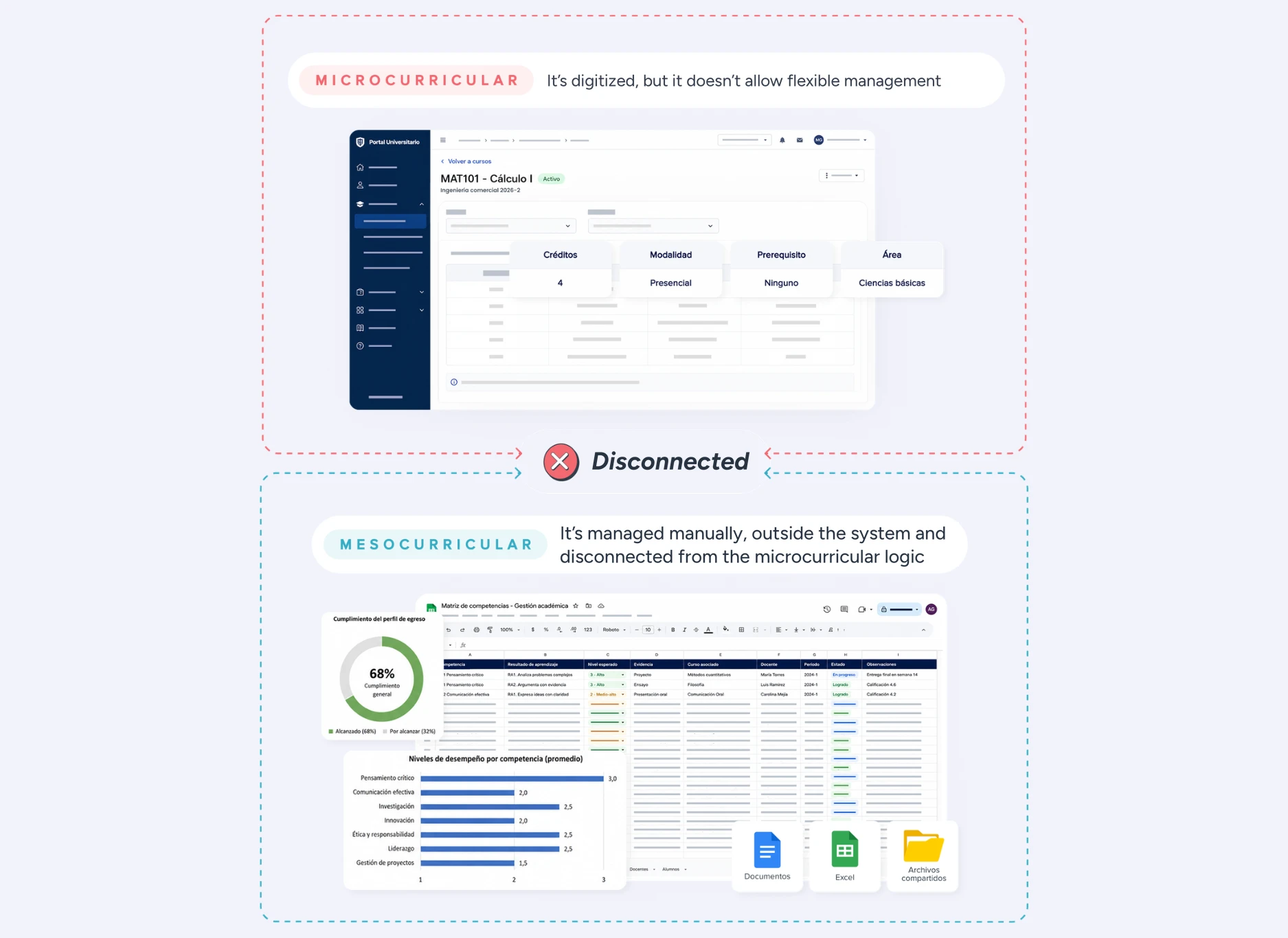
Before talking about platforms, it is worth looking at what this problem looks like day to day at a university in Latin America:
Students see credits but not their progress by competency
A student logs in to the portal, sees a list of passed courses with their grades and credits, and confirms they are 60% of the way through their program. The underlying question stays off that screen: how far have they developed the competencies the university promised them in their graduate profile? To find out, they write to their program director, who in turn has to dig up information that lives outside any system, in a file on their computer.
The curriculum model lives in a file someone updates by hand
The program director who builds the Excel file knows the curriculum model inside out. They know which competencies each academic unit defined, in which courses they are introduced, where they are reinforced, and where they are assessed. The problem comes when someone needs to see where all that knowledge is, because it ends up scattered across a file someone updates now and then, versions circulating by email, and decisions recorded in meeting minutes.
When the accreditation process comes around, that file turns into a weeks-long project to reconstruct what has already happened. During the year, information on what is taught, which competencies are developed, and how they relate to the graduate profile stays scattered, which makes it hard to look up when students, instructors, or prospective students need it.
Rubric-based assessment stays locked in the classroom
Instructors assess their students in the virtual classroom using the program's rubrics and can identify the level of performance achieved. But these assessments tend to stay isolated from the academic system, and the LMS often does not capture learning outcomes or performance indicators, leaving the institution without a complete view of learning.
Curricular Fragmentation: when the curriculum is managed in two parallel systems
When the transactional half of the curriculum lives in the academic system and the formative half lives in spreadsheets, the institution operates with Curricular Fragmentation: it knows its educational model on paper but is flying blind on whether it is actually being met. It is the same Operational Fragmentation that runs through the sector, landing where it hurts most: learning.
Anyone who has sat on a curriculum committee knows the consequences:
- Students are flying blind: they only see credits and grades and don't know how close they are to their graduate profile.
- Making decisions takes too much effort, because the university gets information on learning after the academic term has already ended, when it is too late to adjust the curriculum.
- Accreditation becomes a separate project, and every cycle forces the institution to rebuild the evidence from scratch.
What separates the micro and meso dimensions of the curriculum
In curriculum management, these two dimensions reflect different perspectives on the curriculum and should be connected:
| What it contains | What it sounds like in practice | |
|---|---|---|
| Micro dimension | Courses, credits, requirements, and grades | "They're in their fourth semester and have 78 credits" |
| Meso dimension | Graduate profile, competencies, performance indicators, and learning outcomes. | "They reached an intermediate level in clinical reasoning" |
The micro dimension shows how students are moving through the study plan, while the meso dimension shows what they are learning and how they are progressing.
Foris Suite manages both dimensions of the curriculum in a single model
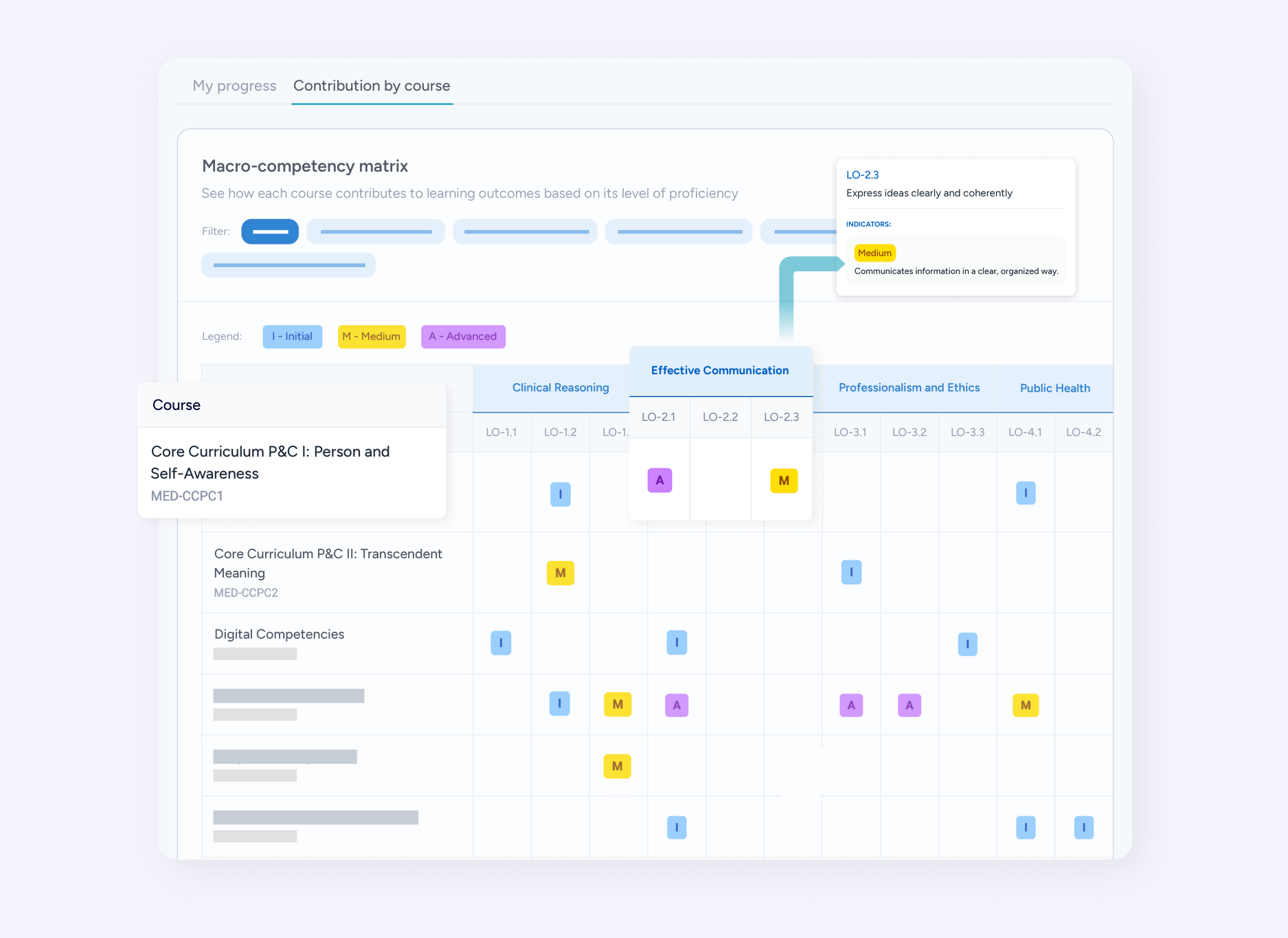
A university knows exactly how many credits each student has earned, but saying just as precisely how much they have learned is another story, and that is the gap this model closes. Foris Suite lets institutions manage both dimensions of the curriculum in the same place and maps the relationship between them, so the study plan and the graduate profile read as a single pathway.
What the micro dimension includes
The student's academic journey, course by course, including their progress through the study plan, the requirements they have met, and their enrollment options.
- Study plan with its sequence of courses, credits, and stages
- Prerequisites and corequisites for each course
- Grades and closing status for each course
- Student progress by credits earned
What the meso dimension includes
The institution's educational model, which today usually sits in spreadsheets and now moves into the platform.
- Portfolio of competencies by academic unit or for the whole institution
- Learning outcomes
- Levels or scales used to state and measure progress by learning outcome or competency (configurable by institution)
- Graduate profile for each program
- Rubrics and performance indicators used to assess each outcome
- Evidence of learning beyond courses, such as internships, capstone projects, microcredentials, and other pathways the institution recognizes
Curriculum mapping is what ties the two dimensions together
For each learning outcome, the system records at what point in the plan (course, internship, capstone project, or other learning experience) it is introduced, reinforced, and mastered, and, where applicable, assessed. That relationship is what lives in a column of an Excel file today, and it is exactly what turns two separate lists into a connected model.
When that relationship is captured in the system, the university can read the curriculum in both directions: from the course, which competencies it develops, and from the competency, at what point in the study plan it is built.
Building and maintaining this mapping by hand is highly error-prone. Foris Suite's AI turns that work into a strategic, ongoing process, with agents that help propose learning outcomes aligned with the indicators and flag inconsistencies in the map, detecting competencies with no coverage or courses that assess learning before it has been introduced.
How does the model work during the semester?
The connected model shows up at four points in the academic term.
At the start of the term: program directors review the graduate profile, adjust the curriculum mapping, and approve the changes within the platform. Each version is recorded with its author and date, ready for any audit.
During the semester: instructors keep assessing in the virtual classroom. With the integration, the program's official rubrics and indicators can be available in both the virtual classroom and the student portal, while each student's results are consolidated in the platform to build their progress by competency, without asking instructors to record anything twice.
At any time: students log in to their portal and see both dimensions together: how many credits they have earned and how close they are to completing their graduate profile. Their academic advisor can access the same information to offer more personalized support and guide students based on their progress and needs.
At the end of the term: the institution reviews learning achievement by program, school, and competency, defines improvement actions, and follows up on them until it can confirm whether learning improved. The evidence for accreditation is assembled as a by-product of day-to-day operations.
Which parts of Foris Suite are involved
Each moment relies on a different Foris Suite component. The academic team works in a single interface, with the architecture underneath:
- Entity Hub: stores the entire curriculum and supports versioning and traceability.
- Data Platform: connects with the virtual classroom and the academic system in both directions.
- Albus is the portal that shows progress to students and their advisors.
- The analytics layer: combines different variables to analyze learning achievement from different perspectives, such as program, school, instructor, delivery mode, student type, and learning outcome level, among others.
Curriculum decisions remain in the hands of academic teams, with the same approval workflows the university already has.
What changes in operations when the curriculum is connected
| Today | With a connected curriculum |
|---|---|
| Competencies live in a shared file | The curriculum model lives in the system, versioned and traceable |
| Students see credits | Students see credits and competencies on one screen |
| Accreditation evidence is rebuilt every cycle, with duplicated effort | Evidence stays available and up to date, and can be exported to different reports based on the institution's needs. |
| Assessment details are not integrated with the institution's curriculum information. | Assessment details are integrated with the institution's curriculum information, making it possible to track learning by competency and learning outcome. |
| Curriculum decisions arrive months late | Decisions are based on what was actually achieved during the term |
The stated curriculum and the lived curriculum in one system
A university spends years defining competencies, learning outcomes, and graduate profiles, and that definition deserves to live in the same model where the curriculum is managed, with the same flexibility to update it, look it up, and make decisions about it. When the two halves of the curriculum share a data model, curriculum design goes from being a document to being an operation that is measured every term.
If you want to see what this would look like with your institution's curriculum model, let's talk.
Frequently asked questions
Do we have to replace the academic system we already have?
The academic system remains the official source of enrollment, credits, and grades. Foris Suite connects to it, reads that progress, and adds the competency layer, the analytics, and the student view. Running both side by side is the usual scenario.
Do instructors have to change the way they assess?
Instructors can keep assessing in the virtual classroom they already use and, when an assessment needs capabilities the LMS does not offer, run it directly on the platform.
The official rubrics and indicators for each competency stay connected to the curriculum model, and each student's results are brought into the platform through integrations (Data Platform) to consolidate progress by competency, without duplicating instructors' work.
How much work does it take to load all the competencies into the system?
Less than it seems when a curriculum inventory already exists. The competencies, graduate profiles, and mappings currently kept in spreadsheets are loaded in bulk and validated. Screen-by-screen entry is reserved for occasional day-to-day adjustments.
What does the university gain in an accreditation process?
The evidence is always ready. The current curriculum mapping, the approved versions of the study plan, the achievement of learning outcomes by program, and the improvement actions can be consulted at any time, with a record of who approved each change and when.