Darwin: AI-powered academic planning for universities
Darwin is Foris Suite's academic planning platform. It optimizes course scheduling, demand forecasting by course, and seat management. It uses AI-based optimization algorithms to generate course offerings with schedule, classroom, and instructor assignments, work that traditionally took weeks of manual coordination. Results include a 60% reduction in process time and savings of up to 20% in the operating budget.
Darwin operates at universities across Latin America and Spain, with more than 65 higher education institutions using it as their academic planning platform.
The problem no one wants to name
Building the course schedule for a term is one of the most complex optimization problems in university operations, since thousands of variables interact at the same time, under multiple constraints and with dependencies on one another:
- Students at different points in their curricular progress
- Instructors with partial availability
- Classrooms with specific capacities and types
- Prerequisite restrictions
- Rules by program and campus
- Cohorts that cannot have schedule conflicts
What looks structured on paper actually operates as a dynamic, interdependent system.
Academic planning is an optimization problem more than a coordination problem.
On top of this complexity comes decentralization: planning does not happen at a single point of control but is spread across units that work with partial information and disconnected systems.
Poor academic planning can cost a university up to 4% of its revenue. Deloitte found that 60% of universities struggle to integrate data from different systems when planning, and The Review of Higher Education documented that 80% operate with decentralized decision-making processes.
The process almost always ends the same way: weeks of work spread across departments, manual cross-checking of information between systems, and seat decisions based more on intuition than on data. The result arrives late, with some sections empty and others overcrowded.
This problem has a name: Fragmented Academic Planning. Each unit manages its part of the process with its own criteria, in different systems, and without visibility of the whole. The final course offerings are the result of multiple negotiations, not of true optimization.
What does Darwin do?
Darwin is the academic planning platform of Foris Suite, designed to centralize and automate the entire cycle: from forecasting student demand to generating optimized course offerings, managing seats in real time, and analyzing the resulting plan.
Darwin turns university planning into a centralized, data-driven system
It does not operate as an isolated system. It connects directly to academic data and uses AI algorithms to solve the problem with computational logic, instead of relying on manual coordination.
The process is structured in four stages:
- Demand forecasting: it simulates the curricular progress of each active student to estimate how many sections of each course need to be opened.
- Schedule generation: based on demand, it produces an optimized academic plan with schedule, instructor, and classroom assignments, respecting institutional constraints.
- Collaborative review and adjustment: in the Schedule Editor, the team reviews the proposal and makes changes as needed.
- Seat management: the seats defined in Darwin sync directly with Albus, our smart enrollment platform, with no intermediate steps.
Demand forecasting: from intuition to real data for each student
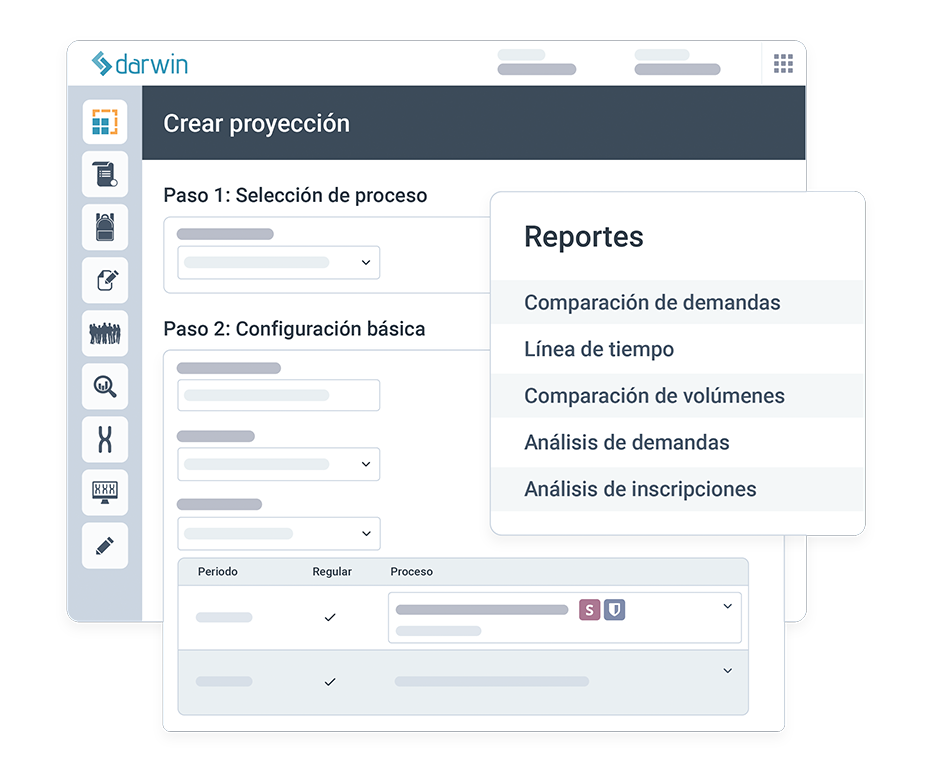
The demand forecasting module is the starting point for all academic planning in Darwin. Its goal is to answer a critical question for any institution: how many students will need each course in the next academic term?
Unlike traditional approaches, which start from historical averages or estimates, Darwin builds the forecast from the most granular level possible: the individual student.
Behind this process is Paul, our demand forecasting algorithm. Its logic models future academic behavior based on real data. To do this, it analyzes the history of each active student, calculates their progress within the study plan, and determines which courses they can take, and are likely to take, in the next term, taking into account prerequisites, course loads, curricular sequences, and institutional rules.
Universities fail because of their limited capacity to process information at scale.
This approach captures the complexity of the academic system instead of simplifying it. Not all students progress at the same pace or make enrollment decisions the same way. Darwin builds that variability directly into the forecast.
From individual simulations, the system builds a consolidated view of academic demand, structured by course, program, cohort, and campus. This forecast is the basis for deciding how many sections to open, where, and with what capacity.
Darwin is not limited to a single estimation model: it can run and compare different approaches depending on the institutional context:
- Enrollment simulation based on curricular progress
- Forecasting from historical academic results
- Regression models on behavior patterns
- Direct conversion of forecasts into operational demand by course
Beyond the model, the differentiator lies in how this information is put into practice. The forecast is managed in the Demand Editor, a module designed so the academic team can explore, validate, and adjust the model's results before using them as the basis for generating the course offerings.
The institution no longer depends on general estimates and assumptions: it works with a traceable forecast grounded in how its students actually behave.
Generating course offerings: automatic optimization with institutional control
With demand validated, Darwin moves on to the Assignments module, where it builds the proposed course offerings. At this stage, the system turns the need for sections into a concrete plan: When is each class taught? In which classroom? With which instructor?
Viktor is Darwin's academic optimization algorithm, designed to generate complex university schedules while meeting multiple constraints simultaneously. Its job is not simply to assign resources (time slot, room, and instructor) but to solve a highly complex optimization problem. To do this, it processes information on instructor availability, classroom capacities and types, time slots, curricular structures, and institutional rules, generating a proposal that is viable and coherent at a global level.
The value lies in generating a schedule and also being able to optimize it globally
What the academic team receives is a proposal ready to be analyzed. The real value, however, lies in Darwin's ability to solve as a whole what has traditionally been managed in fragments. It is not just about assigning an instructor to a room; it is about meeting multiple conditions at the same time:
- Avoiding room conflicts (two classes scheduled in the same space).
- Ensuring that an instructor is not assigned to two classes in the same time slot.
- Guaranteeing that cohorts can take their required courses without schedule conflicts.
- Respecting preferences such as concentrating classes on certain days to make schedules more compact.
- Distributing instructor workload evenly.
All of this happens within each institution's specific rules, which can vary by program, campus, or course type.
This result is possible thanks to a structured process that progressively refines the solution. Darwin starts by loading and validating data, ensuring consistency in instructors, classrooms, and rules. It then builds the base structure of sections and distributes them across the intervals of the academic cycle. From there, it adds further constraints, such as sessions the team has already locked, and identifies schedule packages by cohort so students can take their courses without conflicts.
On this foundation, the system generates multiple candidate solutions and enters an evolutionary optimization process, iterating continuously until it finds the best possible configuration. Finally, it applies post-processing that adjusts and refines the solution to ensure it is operationally viable.
Unlike manual approaches, where the schedule emerges from adjustments negotiated between units, Darwin centralizes this process in a single workflow and runs it in a matter of hours. The impact is direct: up to a 60% reduction in planning time, a 15% optimization in the use of physical infrastructure, and savings of up to 20% in operating costs associated with the use of academic resources.
Seed planning: reuse without starting from scratch
Darwin includes a seed planning feature that reuses an existing plan as the basis for the new term. Instead of building from scratch every time, the team starts from the previous schedule and defines which segments should stay unchanged, and the optimization engines calculate the adjustments needed to adapt to the new demand.
The cycle is iterative by design: simulate, validate, record results, and repeat. With each term, the system accumulates information that improves the quality of the next forecasts.
Managing course offerings
In addition to the optimization engines, Darwin includes a set of modules designed for the academic team to run, adjust, and control the planning process day to day, so they don't just generate the course offerings but can manage them continuously and collaboratively, with full visibility into every decision.
Schedule Editor
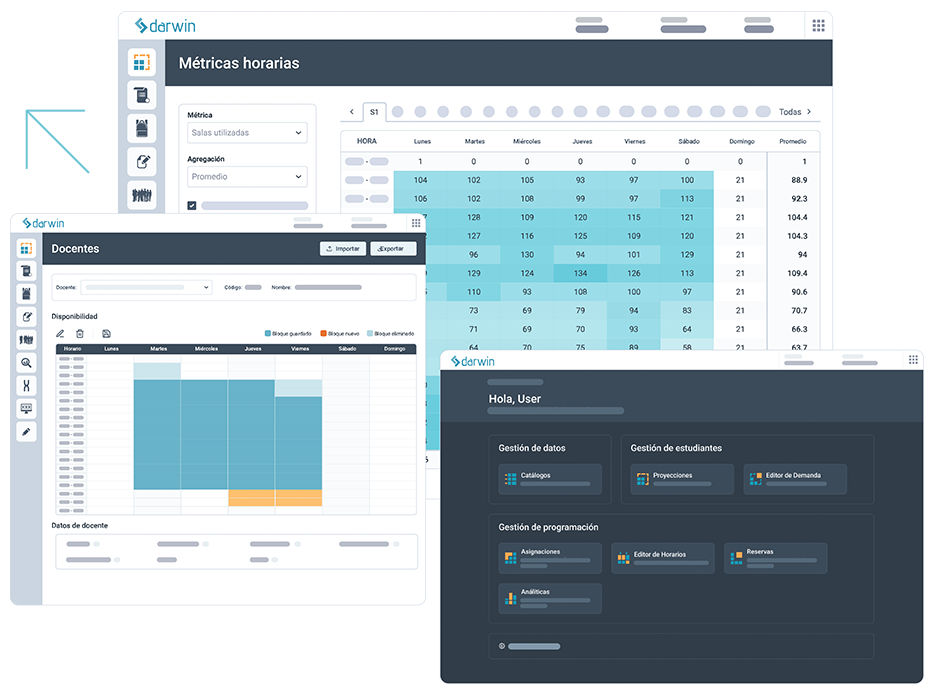
The Schedule Editor is the module where planning becomes a live operation. It enables collaborative schedule editing, with multiple users working simultaneously on the same scenario while keeping every change consistent and traceable.
The team can make adjustments directly to the proposal generated by the algorithm: move sessions, reassign rooms or instructors, and lock specific classes so they are not changed in new simulations. Every action is recorded, which makes it possible to understand how the plan evolves throughout the process.
The Schedule Editor enables collaborative editing, traceability, and real-time validation
The Schedule Editor also includes smart recommendations that help the team make decisions. The system identifies possible improvements to the schedule, such as alternative assignments, conflict resolution, or adjustments that optimize compactness and resource use. This lets the team fix problems and actively improve the quality of the schedule based on data and algorithmic logic.
Seat management
The Seat Manager connects academic planning directly with the operational reality of enrollment (Albus). From Darwin, the team can define and adjust the capacity of each section in real time, ensuring the course offerings respond to forecast demand and current operating conditions.
It is designed to operate at scale. Instead of adjusting section by section, the team can work on the entire course offering centrally: view available seats by course, campus, or curricular combination, spot bottlenecks, and redistribute capacity across sections from a single view. Automatic validations ensure that seats respect physical capacity and the actual state of enrollment.
This module also enables active demand management during enrollment: opening new seats, redistributing capacity across sections, or adjusting the course offerings based on student behavior.
The result is a more agile, aligned, data-driven operation, where planning does not end when the course offerings are published but adapts dynamically to what actually happens.
Space reservations
Darwin extends the management of physical spaces beyond the academic schedule. The Reservations module lets the entire university community request rooms for non-academic activities, such as events, meetings, and extracurricular activities, through a workflow system. Requests are processed taking into account the bookings already in the current plan, which prevents conflicts between the academic schedule and general use of the facilities. The module defines requesting users and administrators, sends automatic notifications on the status of each reservation, and allows requests from mobile devices.
Restrictions Management
Restrictions Management is the eligibility engine built directly into Darwin. It determines, in real time, which students are eligible to enroll in each section of the course offerings, without relying on external systems or manual validations. Rules are configured without code and combine standard and custom attributes: program, campus, delivery mode, student status, and more. The system supports hierarchical logic with automatic inheritance (for example, automatically applying a course's restrictions to all of its sections), which significantly reduces maintenance effort. Every change goes through an approval workflow that ensures governance and consistency in the course offerings.
Analytics
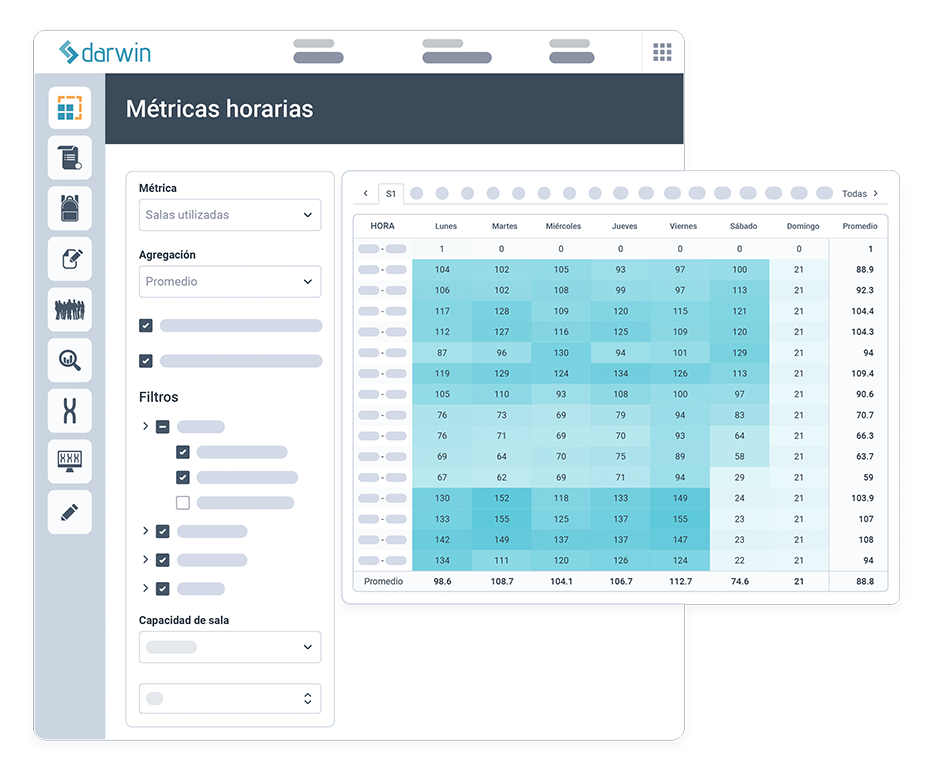
The analytics layer provides visibility into the quality and performance of the plan: room usage by time slot, instructor workload distribution, cohort coverage, instructor availability, and schedule quality for students. These indicators, along with the process's change history, make it possible to evaluate the plan with concrete data and not just perception.
What changes in operations?
The difference between decentralized planning and planning with Darwin is not just speed. It is a change in how the institution organizes, governs, and carries out the entire process.
In the traditional model, planning is fragmented, reactive, and based on negotiation
Each unit manages its part with its own criteria, using different tools and with limited visibility. Coordination happens reactively: conflicts are detected late and resolved through negotiation. The result is not an optimized plan but something built up gradually over multiple versions, where the impact of each decision on the whole system is hard to anticipate.
With Darwin, planning is centralized on a single source of information and a shared operating model. Institutional rules are defined explicitly and are configurable, data is integrated in a single environment, and the process runs in a structured way.
The institution moves from manually coordinating a distributed process to orchestrating a centralized, data-driven system assisted by artificial intelligence.
Once the plan is set and enrollment runs on that foundation, Stella can cross-reference enrollment data with student risk profiles to identify early patterns that deserve the student support team's attention. Planning, enrollment, and student success stop operating as separate processes.
Why is Darwin different from other academic planning tools?
Darwin is one of the AI-powered academic planning platforms available to universities in Latin America and Spain. What sets it apart is that it treats the process as a large-scale optimization problem, not as a digitized version of the manual workflow.
Not all academic planning solutions solve the problem the same way. Many tools on the market focus on digitizing the existing process but keep the fragmented logic institutions have historically operated with.
In this traditional approach, planning still depends heavily on manual configuration, rigid rules, and multiple human iterations to reach a viable result. The system acts as a support tool, not as a true optimization engine.
Darwin takes a different approach: it treats academic planning as a large-scale optimization problem. This translates into four structural differences:
True optimization, not just configuration. While many tools require users to build the course offerings step by step, Darwin generates complete proposals from forecast demand, automatically resolving constraints, conflicts, and dependencies. The result is not the sum of manual decisions but a globally optimized solution.
An integrated model, not a fragmented one. Instead of separating forecasting, assignment, and seat management into independent processes, Darwin connects the entire cycle in a single platform. This eliminates inconsistencies between stages and means every decision has a direct impact on the whole system.
Operations guided by data, not intuition. Darwin includes student-level forecasting models, smart recommendations in schedule editing, and built-in analytics to evaluate results. This lets decisions rest on real data rather than assumptions or accumulated experience.
Institutional control without technical complexity. Rules, restrictions, and operating conditions are configured without code, so academic teams stay in control of the process without depending on technical development or complex system adjustments.
Fragmented Academic Planning is not a problem of will or resources: it is an architecture problem. When demand forecasting, schedule generation, and seat management operate in an integrated system, the process no longer depends on manual coordination and starts working as true optimization.
Want to see how Darwin would work at your institution? Book a demo with our team and we'll show you the system live. Or visit the Darwin page to learn more.
Glossary: key terms in this article
Darwin: Foris Suite's academic planning platform. It centralizes and optimizes the entire university course scheduling cycle: demand forecasting, schedule generation with time slot, room, and instructor assignment, seat management, and planning analytics.
Fragmented Academic Planning: a structural problem in university operations in which each academic unit manages its part of the process with its own criteria, in different systems, and without visibility of the whole. It leads to schedule conflicts, suboptimal seat decisions, and delays in delivering the course offerings.
Viktor: Foris's proprietary multi-phase evolutionary algorithm behind Darwin's Assignments module. It implements a metaheuristic approach that combines genetic algorithms, local search, graph search, greedy algorithms, and integer linear programming algorithms, which lets it explore millions of combinations. It also includes an evolutionary memory structure that accumulates information from previous runs and steers the search toward more promising solutions, progressively improving the quality of the results.
Paul: Foris's proprietary demand forecasting algorithm behind Darwin's demand forecasting module. Its job is to predict, term by term, which courses each active student will take, course by course and student by student, and aggregate those individual forecasts into demand figures by course.
Seed planning: a Darwin feature that reuses an existing plan as the basis for the new term, letting the algorithms calculate adjustments to what has already been built instead of starting from scratch.
Restrictions Management: an eligibility engine built into Darwin that determines in real time which students are eligible to enroll in each section of the course offerings. It supports hierarchical logic, automatic inheritance, and no-code configuration.
Schedule Editor: a Darwin module for collaborative schedule editing. It supports multiple users working simultaneously, smart adjustment recommendations, manual session locking, and full traceability of changes.
Frequently asked questions
What is Darwin by Foris?
Darwin is Foris Suite's academic planning platform. It optimizes course scheduling, demand forecasting by course, and seat management with proprietary AI algorithms, so university teams can build each term's course offerings with less manual coordination and more control over the results.
How much time does Darwin save in the academic planning process?
Institutions using Darwin report a 60% reduction in the total time of the planning process. Darwin consolidates what used to take weeks of coordination across academic units into a centralized process that the team reviews and adjusts.
Does Darwin replace the academic planning team?
No. Darwin works alongside the team: the algorithms generate and optimize, and planners review and adjust in the Schedule Editor. Institutional decisions remain in human hands; Darwin removes the repetitive operational workload so the team can focus on higher-value decisions.
How does manual demand forecasting differ from Darwin's?
Manual forecasting starts from historical averages or aggregate estimates. Darwin builds the forecast from the most granular level possible: it simulates the curricular progress of each active student individually, taking into account prerequisites, course loads, curricular sequences, and institutional rules.
Does Darwin integrate with the university's existing SIS?
Yes. Darwin is part of Foris Suite, which is designed to integrate with the university's existing ecosystem, including the SIS and the ERP. It centralizes planning operations without replacing the institution's systems of record.
What results do universities get with Darwin?
Institutions using Darwin report a 60% reduction in planning process time, a 15% optimization in the use of physical infrastructure, and savings of up to 20% in the process's operating budget.