Foris Suite: the university management platform designed for the AI era
Foris Suite is an AI-native university management platform that automates the most complex processes of academic operations: from demand forecasting and schedule generation, through enrollment, to the early detection of at-risk students. It is developed by Foris.ai, an edtech company operating at more than 65 universities in 10 countries across Latin America and Spain and reaching more than one million students.
More than an isolated system, it works as a central intelligence and management layer that integrates with the institution's existing technology ecosystem, connecting data, processes, and decisions in one coherent experience.
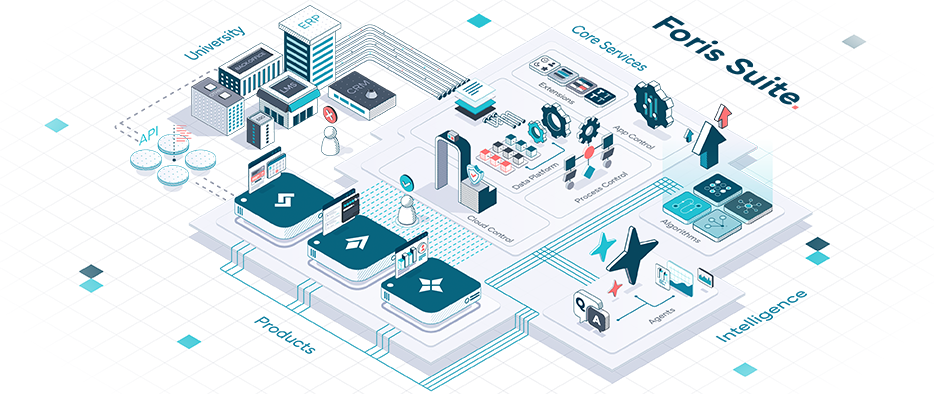
Operational fragmentation: systems that work but aren't integrated
At most universities, technology fails because of a lack of integration between systems, more than because of the quality of the tools themselves.
The academic system (SIS) manages records, the financial system handles charges, the LMS supports the learning experience, and the CRM tracks prospective students. Each one does its job, but the university operates as a network of connected decisions and processes, not as independent silos.
That is where friction appears. When the time comes to make decisions or carry out complex processes, such as opening sections, planning schedules, or intervening with at-risk students, information does not flow naturally between systems. Data is fragmented, rules live in multiple places, and processes are not connected end to end.
This problem, common across the university technology ecosystem, is known as Operational Fragmentation: systems that work individually but fail to operate as a coherent whole. As a result, teams end up depending on:
- manual cross-checking of information
- reports that arrive late or require multiple validations
- operational knowledge that is undocumented and lives with a few people.
The result is an operation that is slower and more expensive than it should be.
Foris Suite was created to solve this problem: it acts as a layer for systems integration, process automation, and data intelligence, so the university can operate as a single unit.
Foris Suite is one of the AI-powered solutions available to universities in Latin America and Spain. Unlike approaches that add AI on top of existing systems, the platform was built as an AI-native system in which intelligence is part of the design, not an additional layer.
What changes when AI isn't an add-on?
Many platforms today include artificial intelligence, but in practice it usually sits at the edges: a chatbot, a dashboard, an isolated prediction.
Foris Suite works differently: AI is at the heart of how processes are carried out.
This translates into concrete actions:
- A student can enroll in courses without having to understand complex rules, because the system already takes them into account and suggests the best possible decision for their context.
- An academic team can avoid weeks of manual iteration when building the course schedule, since the system can generate it in minutes, even at universities with hundreds of active sections per term.
- A student support advisor can know whom to contact and why, without going through multiple reports.
None of this happens because there are "AI features." It happens because the platform was designed with an AI-native model, so that intelligence is the mechanism that runs the processes.
This is achieved through four key capabilities:
- Built-in Agentic Tools: data and processes are available as tools for AI agents. There is no need to "connect" intelligence; it is already part of the system.
- Unified Data Gateway: all information, including what comes from existing systems, is available at a single point in real time.
- Agents Platform with institutional knowledge: the agents are not generic; they understand university rules, curricula, and the specific complexity of each institution.
- Natural language as the interface: people can work naturally without having to adapt to the system, because the system understands how they work.
AI stops being an additional layer and becomes the way the university operates.
Foris Suite products
Foris Suite has three main products, each focused on a critical moment in university operations. Although they play different roles, they share data, rules, and logic, so the institution works as an integrated system.
Darwin: optimized academic planning
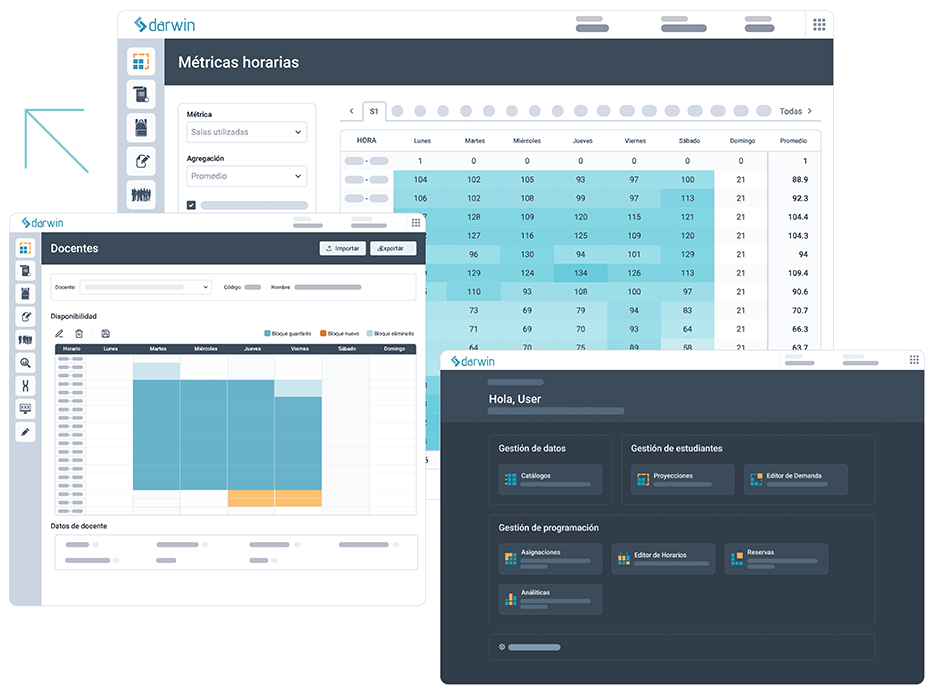
Darwin transforms how universities plan their academic operations. It orchestrates the assignment of schedules, instructors, and classrooms as an integrated system that forecasts student demand, simulates assignment scenarios, and adjusts operations to actual demand, powered by AI optimization engines that evaluate multiple variables simultaneously.
The platform builds and optimizes schedules taking into account instructor availability, classroom capacity, academic rules, and enrollment forecasts. These optimization engines generate more efficient configurations, balancing constraints and objectives to find the best possible combinations. From there, teams can create scenarios, simulate decisions, and understand their impact before carrying them out.
Instead of a manual, iterative process, planning becomes a continuous workflow in which resource assignment, seat management, and reservations adjust dynamically.
The results are concrete: 60% less time spent on the academic planning process, a 15% optimization in infrastructure use, and up to 20% savings in the operating budget. Planning stops being a static exercise and becomes a living system that can adapt and make better decisions every academic cycle.
Albus: smart course enrollment
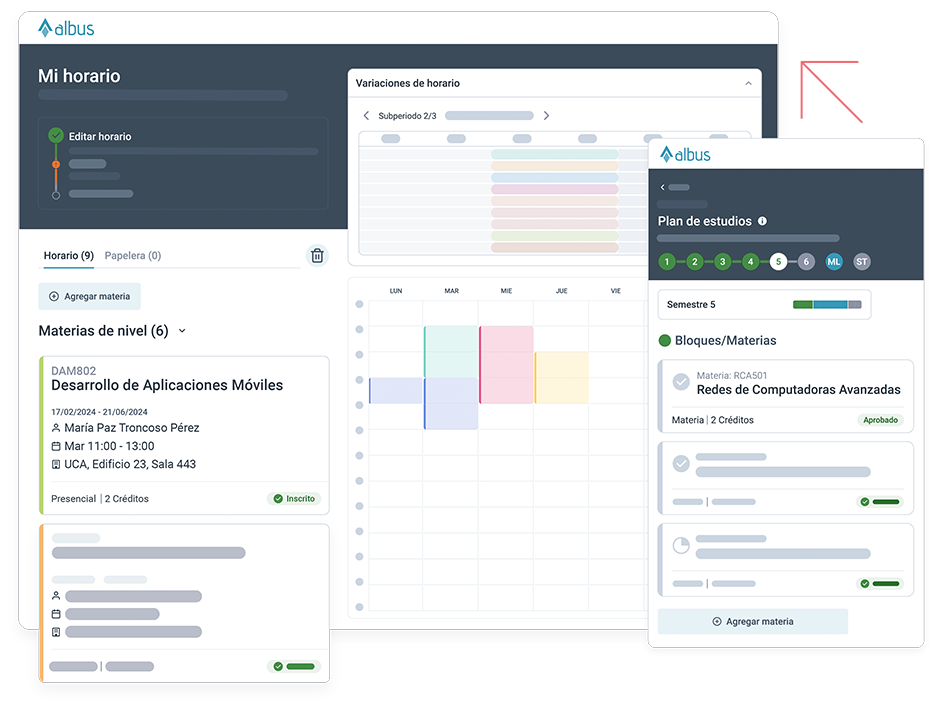
Albus is designed to transform course enrollment, guiding students through one of the most complex moments of their university life, choosing courses and schedules, with AI recommendation engines that understand their academic context and preferences.
From the start, the platform gives students a schedule proposal that complies with academic rules and their curricular progress. Instead of building their enrollment from scratch, students start from an optimized recommendation that they can adjust to their needs.
From there, they can:
- Understand their curricular progress in real time
- Adjust their schedule with suggestions based on availability and preferences
- Enroll in courses and select sections with a reserved seat
- Check their financial status without switching systems
- Get recommendations on which decisions to make and when.
Albus interprets the student's situation and suggests the best combination of courses and schedules, taking into account prerequisites, academic rules, seat availability, and their progress through the study plan.
The result: more than 70% of students accept the generated schedule proposal, average enrollment time drops to 15 minutes, and up to 80% of sessions take place on mobile devices. This improves the student enrollment experience and reduces the operational workload on administrative teams, enabling clearer, guided, and more efficient self-service from the very start.
Stella: efficient student success
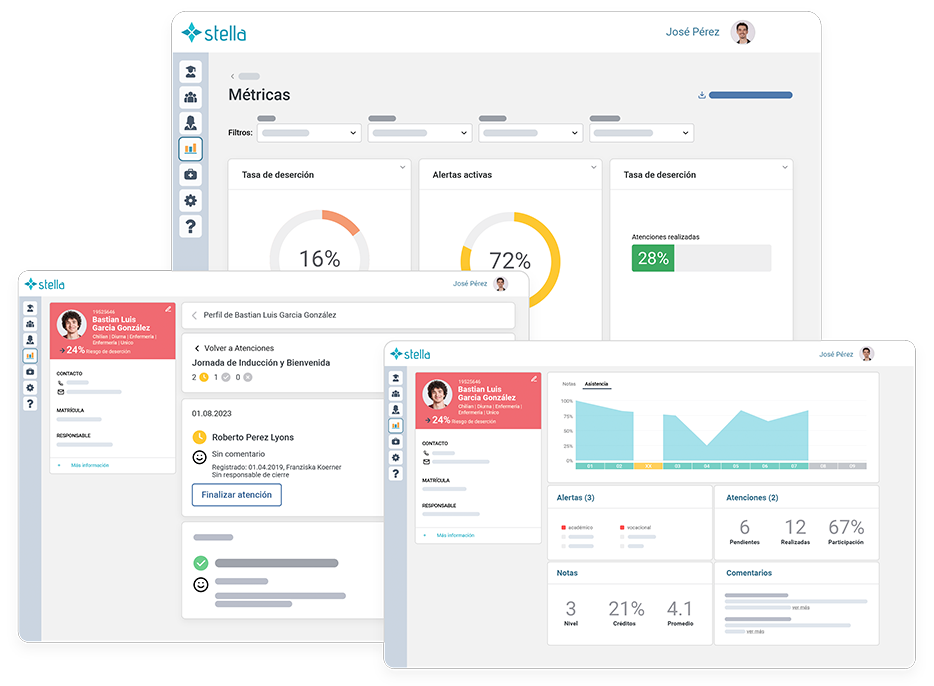
A student's behavior arises from a combination of multiple academic, financial, and behavioral variables that evolve over time, rather than from a single factor or isolated moment.
Stella turns this data into actionable decisions through AI student profiling engines, based on predictive models and advanced analytics, that model student behavior, identify patterns, and explain what is happening in each case. By analyzing risk factors and other relevant outcomes, the platform builds a unified view that shows not only each student's current status but also how it may evolve.
These models, supported by techniques such as decision trees and multivariate analysis, detect risks and opportunities in real time, generating actionable alerts so teams can step in at the right moment and with clear context.
Building on this, the platform lets teams:
- Understand each student's status holistically, beyond isolated indicators
- Detect risks and opportunities in real time
- Generate prioritized alerts for student support teams
- Explain the causes behind each situation
- Manage and follow up on the interventions for each student
Stella not only identifies what is happening but also carries out and coordinates the necessary actions. Results at institutions that use it include a 19% reduction in semester dropout, 86% accuracy in predicting student outcomes, and up to 48% effectiveness in intervention actions.
This improves student persistence, optimizes support, and ensures that every student receives the right attention for their situation.
Core Services: the layer that makes everything work as one system
University operations depend on how data, processes, and rules are connected. When these elements are split across systems (SIS, ERP, LMS), information is duplicated, processes become manual, and management loses consistency. Core Services solve this through a layer that:
- Integrates academic, financial, and operational data from multiple systems into a single source of truth
- Orchestrates processes automatically, replacing manual workflows and point-to-point integrations
- Configures business rules (academic, financial, operational) dynamically, without depending on development
- Manages identity and access, ensuring control and consistency across users and systems
- Enables real-time analytics and data use for decision-making
On this foundation, the platform can run processes at scale and support artificial intelligence models that operate across the board, using consistent data and generating actions directly on operations. The university thus stops depending on isolated systems and starts operating as an integrated system, where information flows, processes run in a coordinated way, and decisions are made with full context and in real time.
Intelligence: AI as the engine of operations
Foris Suite is designed so that its data, processes, and rules can be consumed directly by artificial intelligence models. This means AI not only analyzes operations but acts on them in real time.
The platform is a hybrid intelligence ecosystem that combines optimization algorithms, predictive models, and generative AI capabilities (LLMs) to solve different problems with the most suitable technique in each case: from planning and demand forecasting to student profiling and process automation in natural language.
Building on this, intelligence makes it possible to:
- Optimize and simulate complex scenarios
- Predict behavior and detect patterns
- Explain decisions with interpretable models
- Activate agents that operate on the platform in natural language
More than an analytics layer, intelligence at Foris executes, learns, and continuously adapts, becoming a cross-cutting engine that strengthens every decision in academic operations. Altogether, Foris Suite connects planning, enrollment, student support, data, and intelligence in a single platform, so the university can operate as an integrated, real-time, AI-native system.
Want to see how Foris Suite works at a university like yours? Book a demo or visit our Foris Suite page.
Glossary: key terms in this article
Foris Suite: an AI-native university management platform that brings data, processes, and decisions together in a single system. It includes three products (Albus, Darwin, Stella), Core Services as the infrastructure layer, and an intelligence layer with optimization algorithms, ML, and AI agents.
Operational Fragmentation: a structural problem of the university technology ecosystem in which systems (SIS, ERP, LMS, CRM) work individually but fail to operate as a coherent whole, leading to manual cross-checking, late reports, and disconnected processes.
AI-native: a design model in which artificial intelligence is not an add-on to an existing system but the core mechanism that runs the processes. In Foris Suite, AI generates schedules, forecasts demand, recommends enrollments, and detects student risk in an integrated way.
Core Services: Foris Suite's cross-cutting infrastructure layer, which brings data together into a single source of truth, orchestrates automated processes, and manages identity, access, and business rules for every product in the suite.
Frequently asked questions
What is Foris Suite?
Foris Suite is an AI-native university management platform that automates the most complex processes of academic operations: from demand forecasting and schedule generation, through enrollment, to the early detection of at-risk students. It is developed by Foris.ai, an edtech company operating at more than 65 universities in 10 countries across Latin America and Spain and reaching more than one million students.
What is operational fragmentation in universities?
It is the structural problem of the university technology ecosystem: systems that work individually (SIS, ERP, LMS, CRM) but fail to operate as a coherent whole, leading to manual cross-checking of information, late reports, and disconnected processes.
How is Foris Suite different from a traditional SIS?
A traditional SIS was designed for transactional record-keeping. Foris Suite was designed from the ground up as an AI-native system in which intelligence is not an add-on but the mechanism that runs the processes: it generates schedules, forecasts demand, and intervenes with at-risk students automatically. It integrates with the other systems in the university ecosystem, such as SIS, LMS, and CRM platforms, among others.
What products does Foris Suite include?
Foris Suite includes three products: Darwin (optimized academic planning), Albus (smart course enrollment), and Stella (efficient student success). They all share data, rules, and logic through Core Services and Intelligence, so the institution works as an integrated system.
What are Foris Suite's Core Services?
They are the cross-cutting infrastructure layer that brings academic, financial, and operational data together into a single source of truth, orchestrates automated processes, configures dynamic business rules, and manages identity and access across all products.
In which countries does Foris Suite operate?
Foris Suite is developed by Foris.ai, an edtech company present at more than 65 higher education institutions in 10 countries across Latin America and Spain, reaching more than one million students and more than 60,000 academic staff members. Foris.ai was founded in Santiago, Chile, in 2014.