How do you connect data and processes in the age of AI to break down silos?
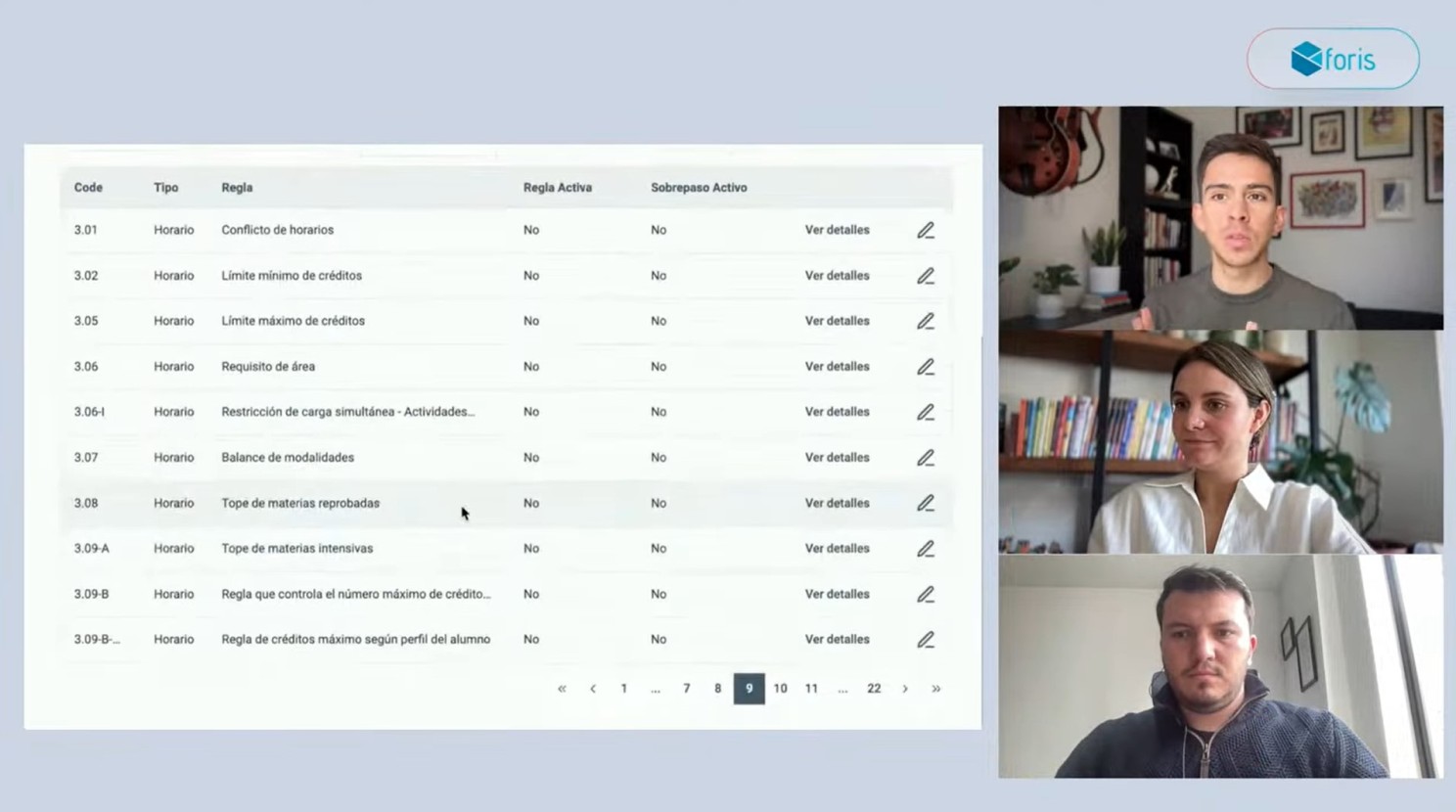
Universities face a crucial challenge: leaving isolated systems and processes behind. Connecting their operations is not only an immediate need but also the foundation for using artificial intelligence and analytics with real impact.
This episode featured Felipe Meneses D., CEO; Franziska Körner, Head of Product; and Manuel Vargas, Director of Implementation & Service, who discussed:
- The generative AI divide – Project NANDA, MIT Report 2025.
- Experiences using AI tools at higher education institutions.
- Breaking down data silos: recommended tools and applying AI.
- Breaking down product silos: cross-cutting capabilities for non-technical roles (Core Services).
We're sharing a highlight reel with the best moments of the webinar. You can watch the full episode here: https://www.youtube.com/watch?v=hhmt-azI0bY&t=478s
The GenAI Divide: State of AI in Business 2025 – What MIT reveals about real-world AI adoption
According to the MIT Nanda Report 2025, only 5% of investments in artificial intelligence reach production; the remaining 95% stays in the exploration, training, and testing stages. This figure should not be read as a weakness but as an opportunity: we are still in an early phase of adoption, with room to experiment, learn, and prepare before disruption becomes inevitable.
"Today we're in a stage of high adoption, but there's still little real disruption. That opens up a huge opportunity to prepare ahead of time." Felipe Meneses, CEO
The MIT Nanda Report 2025 analyzed 52 companies and more than 300 AI projects in the public sector, and its findings are revealing:
- There is an investment bias. More resources go to user-facing initiatives than to the back office, even though that's where the greatest real return lies.
- Projects developed with support from external partners are twice as likely to succeed as those managed solely by internal teams.
- High distrust of new vendors persists; in this context, peer recommendations remain the most decisive factor when choosing partners.
Although AI disruption hasn't arrived yet, adoption is already underway, and preparing now is key. This means working on three fronts:
- Data: ensuring quality, availability, and interoperability.
- Integrations: connecting multiple systems and workflows.
- Culture: promoting AI literacy at the individual, team, and organization-wide level.
The experimentation phase is essential because it shortens the learning curve and lets institutions take full advantage of AI when disruption arrives.
Lessons and challenges in implementation
Implementing agents and LLMs teaches us a key lesson: adopting artificial intelligence is not only a technological challenge but also one of integration, systematization, and organizational culture.
Universities often start out expecting to achieve a fully connected ecosystem in which products and services run almost autonomously thanks to LLMs. In practice, however, they run into concrete challenges:
- Integration with multiple sources and internal systems: connecting agents with such a wide range of platforms is still a complex challenge.
- Systematizing business rules: the need to replicate scenarios can introduce bias into the models or limit their ability to generalize.
- Adapting teams and processes: preparing people to adopt new tools and workflows is critical to success.
These experiences show that adopting LLMs goes beyond technology. It requires a comprehensive approach that covers data, systems, processes, and organizational culture in order to achieve effective, truly scalable results.
Unifying data and processes: the Piper experience
Consolidating data, standardizing processes, and connecting technical and functional users has become an essential step for artificial intelligence to create real value at universities.
While there are many challenges, one of the most critical has always been data: because it is semi-structured or unstructured, it has created silos that are hard to break down. To overcome this barrier, we developed Piper, our data integration and transformation service within Foris Cloud Education Suite. Piper is designed to revolutionize the way universities connect, process, and distribute data, drastically reducing time and costs in integration projects and even making it possible to handle complex data without advanced programming.
Here's what Piper makes possible:
- Data consolidation and standardization: all information is transformed for analysis and validation.
- Automatic translation of entities and relationships: students, courses, instructors, and the links between them are unified in a common framework.
- Infrastructure optimization and cost reduction: achieving more with fewer resources. It eliminates custom development, reduces the need for specialized technical staff, and allows components to be reused across projects.
- Secure, multi-tenant operation: managing multiple environments reliably, with universal connectivity to databases, cloud storage, modern APIs, and structured files.
- Consistent business rules: these make modeling and standardization easier across all processes.
- Faster time to market: integrations in days instead of months, and autonomous business users.
"Piper lets us break down data silos and establish a common language that connects scattered information and turns it into real value." Manuel Vargas.
Once the data is consolidated, the next step is getting teams to speak the same language. That's where SQL and Amazon Athena come in, acting as a bridge between the technical and the functional. These tools let consultants and business teams work directly with data, combining their business knowledge with modeling and analytics. This speeds up processes, leads to more effective implementations, and makes it easier to produce AI-driven reports that bring real value to end users. Together, these tools open up access to data and enable technical and functional teams to collaborate with more agility, speed, and efficiency.
Breaking bottlenecks: dynamic regulations and intelligent systems
At universities, regulations change constantly, often every semester, and systems need to be agile enough to adapt without creating bottlenecks.
The problem is common: every regulatory update usually means modifying the code, causing delays, cost overruns, and unnecessary operational complexity.
Experience has shown us that the best way to meet this challenge is to separate business rules from code and move them to a central configuration layer (Core Services). With this approach, institutions achieve:
- Hyper-flexibility and fast customization in response to any regulatory change.
- Seamless translation between human language and machine language.
- Management of complex rules without constantly depending on technical teams.
"We embrace the pace of change at universities by creating modular, configurable, and centralized tools that can react quickly to any regulation or requirement." Franziska Körner.
Watch the webinar and discover how we're connecting data, processes, and people to transform academic operations with artificial intelligence: https://www.youtube.com/watch?v=hhmt-azI0bY&t=478s