AI agents: how they're handling academic operations today
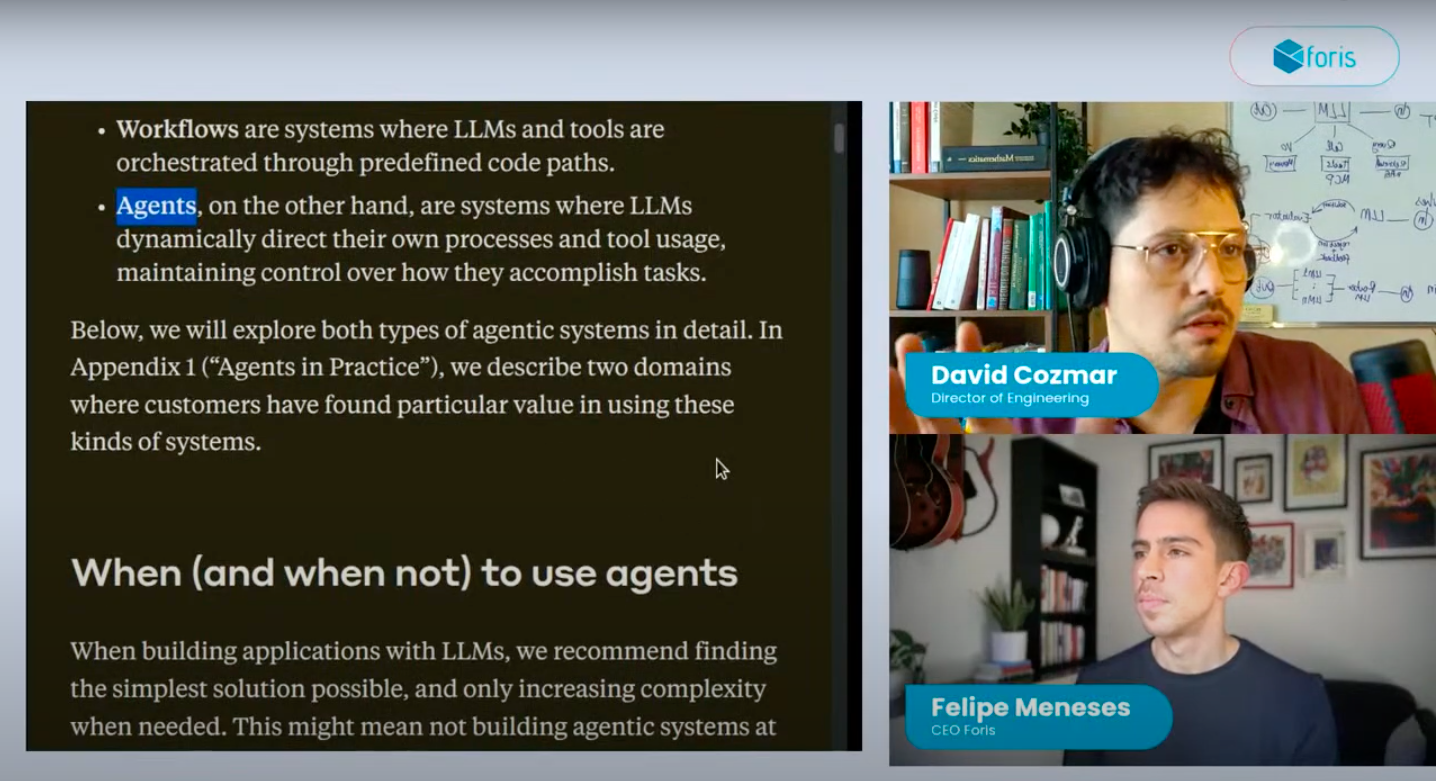
In our latest webinar, we explored a topic that is revolutionizing every market, and higher education in particular: the role of AI agents in university management.
We were joined by Felipe Meneses D., CEO, and David Ignacio Cozmar R., Director of Engineering and Artificial Intelligence at Foris, who answered key questions:
- What exactly are AI agents, and how are they different from language models (LLMs)?
- What real, practical use cases exist at universities today?
- If AI promises productivity, why aren't we seeing a radical change in institutions' day-to-day work yet?
More than assistants: the value of building agents
We're bringing generative AI into our daily tasks more and more, and although it's here to stay, its use is often limited to basic "digital assistant" functions that aren't truly integrated into workflows. This is where AI agents make the difference: a layer of transformation that works alongside people and takes on tasks we once thought only humans could do. Although this disruption hasn't fully taken hold in the workplace yet, agents promise to change that.
Building an agent doesn't just mean automating a task; it's a strategic investment. By defining and mapping the tasks involved in detail, the organization gains knowledge and keeps its processes up to date, transparent, and explorable. Language models help organize that content flexibly, adding value beyond automation. That's why, rather than getting carried away by the hype, the key is to focus on how to empower our most valuable resource—people—by deploying them effectively alongside technology, not just to save costs, but to create things that weren't possible before.
Where do they have the greatest impact at a university?
They're especially useful for tasks that require direct communication with people, such as students, instructors, and staff, where personalized interaction is key but the volume is very high. They also help tackle problems stemming from the large number of users and the specific nature of each request, optimizing management with fewer staff and higher productivity.
In higher education, agents shine in areas such as:
- Supporting students with academic or administrative alerts.
- Managing instructor schedules dynamically.
- Automating communications and follow-up in complex processes.
To identify where to apply these agents, it helps to have a framework for evaluating mature use cases with a clear return and added value.
What makes an AI agent unique?
Unlike traditional software, an agent:
- Interacts with an environment (the internet, internal systems, databases, etc.).
- Makes decisions, takes action, and receives feedback.
- Combines tools, validates information, and adjusts its plan until it achieves a goal.
An agent can search for a flight, check a student's schedule, send an email, and so on. What's crucial is that it doesn't follow a fixed script: it combines tools, consults sources, validates information, and acts until it achieves a goal, just as a person would at work. David Ignacio Cozmar R.
But developing an effective agent isn't a plug-and-play process. It requires much deeper technical and integration work, including:
- Integrating critical tools such as LMS and CRM platforms, calendars, and financial systems.
- Enabling read and write functions in internal systems, ensuring the agent can interact with information in both directions.
- Managing "action feedback," that is, the interaction loop that connects the agent with its environment and confirms that its actions produce the expected results.
- Coordinating with vendors or developing in-house solutions to ensure compatibility and interoperability.
In a university setting, this can mean connecting dozens of platforms, although usually 5 or 6 of them are critical for the agent to work effectively. Achieving this means not only opening up access to those tools but also working closely with vendors on the technical side or, failing that, building custom integrations.
Ideally, platforms will one day expose their features in a tool catalog that any agent can access, just as APIs revolutionized the web. Felipe Meneses D.
Current limitations of language models (LLMs)
Although LLMs have impressive capabilities—such as reasoning, apparent memory, and planning—it's not enough to connect them to an environment and expect them to work better than a person. They still have significant limitations:
- They don't understand the physical world: their knowledge is linguistic, not experiential.
- They don't have real memory: they simulate remembering data injected into each interaction.
- They don't genuinely reason: they imitate reasoning but don't actually carry it out.
- They don't plan: they follow instructions but don't design complex strategies.
This means critical decisions can't be delegated without human oversight. The current paradigm is "human-in-the-loop": the agent assists, the human decides.
The future of AI agents in higher education
Research such as The Illusion of Thinking has shown that, although an LLM can solve specific, technical tasks, its performance drops on complex problems that demand deep understanding or sustained planning.
The race to overcome the limitations of LLMs and AI agents is on, but we haven't reached the ideal point yet, so important decisions must remain in human hands. These tools are powerful for expanding the team's knowledge and capabilities, automating repetitive tasks, and providing technical support, but not for replacing professional judgment or human experience.
Revolutionizing university operations: Foris Agents in action
At Foris, we don't just talk about AI agents; we're developing them to solve different academic operations challenges. Our goal is for every institution to have specialized agents tailored to its needs, able to integrate with its systems and support students, instructors, and staff in key processes.
Our approach aims for agents that can:
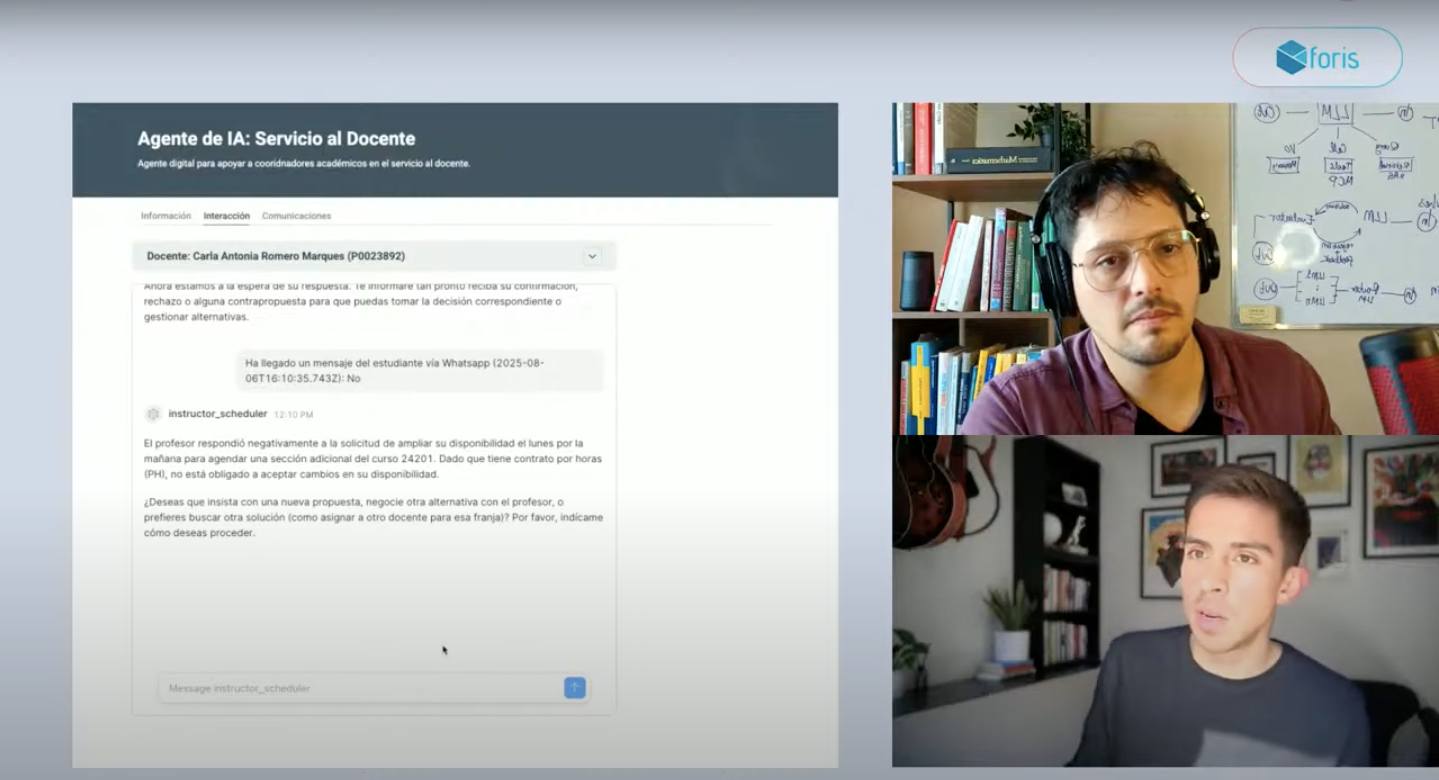
- Handle personalized requests at scale: from answering questions about schedules to guiding a student with academic alerts toward the best solution.
- Manage calendars and reminders: coordinate meetings or tutoring sessions with instructors, send automatic reminders via WhatsApp or email, and facilitate schedule negotiations.
- Connect with institutional systems such as LMS and CRM platforms and calendars to automate tasks without duplicating effort.
- Support academic planning: propose and negotiate instructor schedules, optimize course assignment, and respond to last-minute changes.
- Act with intelligence and human oversight: work autonomously on repetitive tasks, but always with validation on critical decisions to ensure quality and accountability.
At universities with thousands of students and limited teams, these agents become a strategic ally for streamlining communication, optimizing processes, and offering truly personalized support. Our commitment is not to create generic agents, but solutions that understand the university context and fit naturally into academic operations.
We invite you to watch the webinar and see live how our agents are already transforming university management: https://youtube.com/live/tZxTAg1jT4g