Optimized spaces: a new paradigm for Universidad de Talca
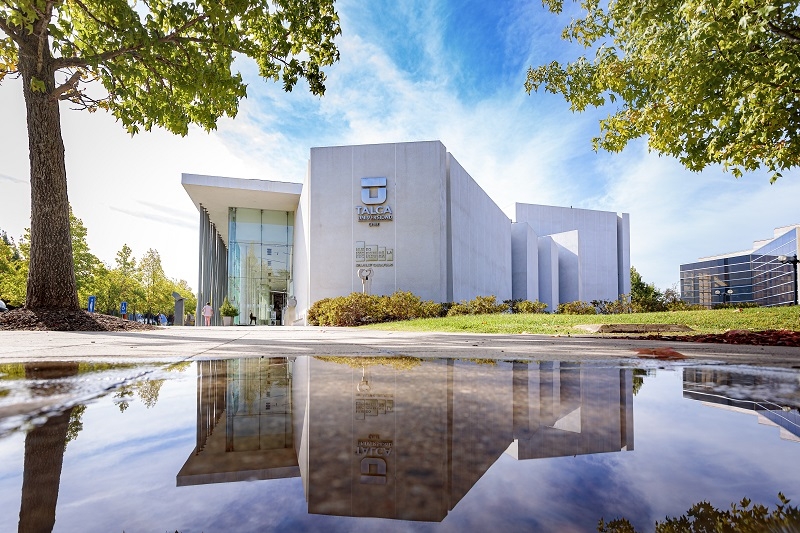
In the heart of the Maule Valley, between the Andes and the Coastal Range, stands Universidad de Talca (UTalca), a regional public institution and a leader in Chilean higher education. Since 1981, UTalca has grown and established itself as a benchmark for public, nonprofit higher education.
It has five campuses, strategically located in the Maule, Libertador Bernardo O'Higgins, and Metropolitan regions, serving more than 8,500 students.
In its constant pursuit of excellence, UTalca decided to roll out Darwin across its campuses to optimize the assignment of physical spaces and automate a process that had historically been arduous and highly complex.
Before Darwin: challenges and limitations
Assigning physical spaces was an arduous task for the operations teams at each campus. The number of rooms and courses at the largest campuses made it hard to assign spaces efficiently, so the teams had to do it by hand, spending many hours on the work with a high risk of errors in the assignment. Infrastructure capacity problems in certain time blocks were also discovered too late, causing further complications.
As a result, the lack of early visibility into space availability made it hard to make decisions and to adjust or change schedules in time, which hurt academic activities and caused problems for both administrative staff and students.
Time for change! Aware that the process needed optimizing, UTalca evaluated several alternative solutions and ultimately chose Foris and its product Darwin, for its proven track record at many universities, the product's strong value proposition, and the great potential of Foris Cloud Education Suite's other tools.
Implementing Darwin
It was rolled out at four of the university's campuses: Lircay, Curicó, Pehuenche, and Santiago. The implementation team included the room assignment officer, a member of their staff, the head of the Curriculum Management Department, and several representatives from the IT department. The project kicked off in October 2021 with a detailed implementation plan, which included successive training sessions for the Curriculum Management team and the IT department.
Meanwhile, the university worked internally to gather the data needed to feed Darwin. After joint testing across different scenarios and an evaluation of the results, the project went live in the first week of March 2022. The Curriculum Management office, for its part, developed practical procedures to support campus administrators, so they could use the system easily and get the results they wanted. This made Darwin simpler to operate, since it offers a wide range of configuration options that have to be evaluated and tailored to the university's needs.
Notable results
- UTalca was able to simulate multiple scenarios and make informed decisions to adopt the best solution.
- Darwin made it possible to reconsider building new infrastructure, since spaces previously reserved for other activities, such as auditoriums and executive rooms, could now be made available for academic planning.
- The most in-demand time blocks were identified, along with others where infrastructure was underused, so the university could consider moving certain courses to other time slots and make the most of its available spaces.
- Darwin made it possible to automate room assignment and run simulations under different assumptions.
Optimization and technology expansion
With Darwin, the university optimized the assignment of physical spaces across all four campuses, saving time and resources. Automating this process enabled the institution to make strategic decisions and use its available spaces more efficiently.
Universidad de Talca continues on its path toward excellence and is now expanding Darwin to its Linares and Colchagua campuses, making the most of technology to give its students a higher-quality education.